BuildBreathe™ Roofing Underlayment – High-Performance Vapor-Permeable Barrier for Structural Health
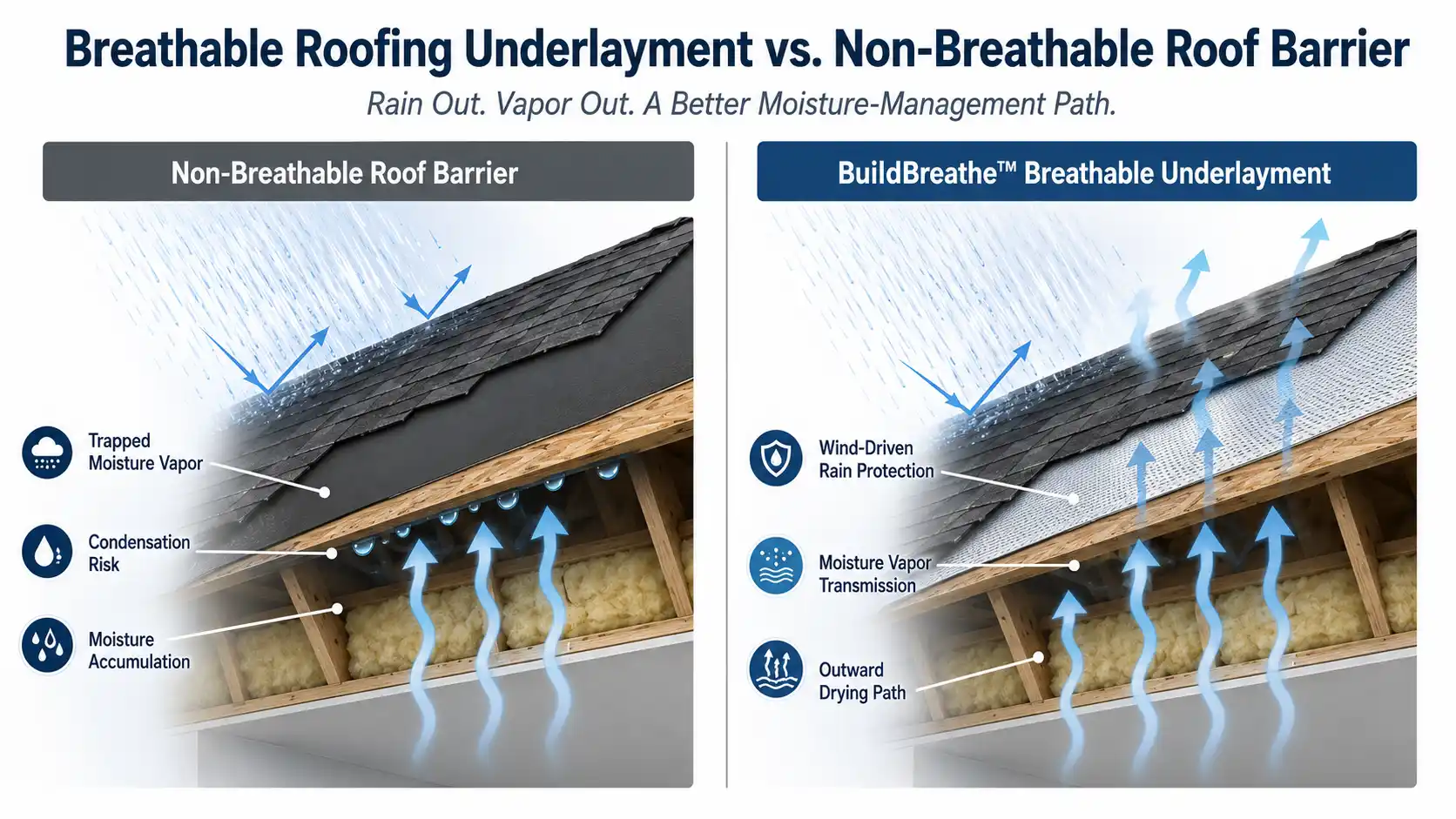
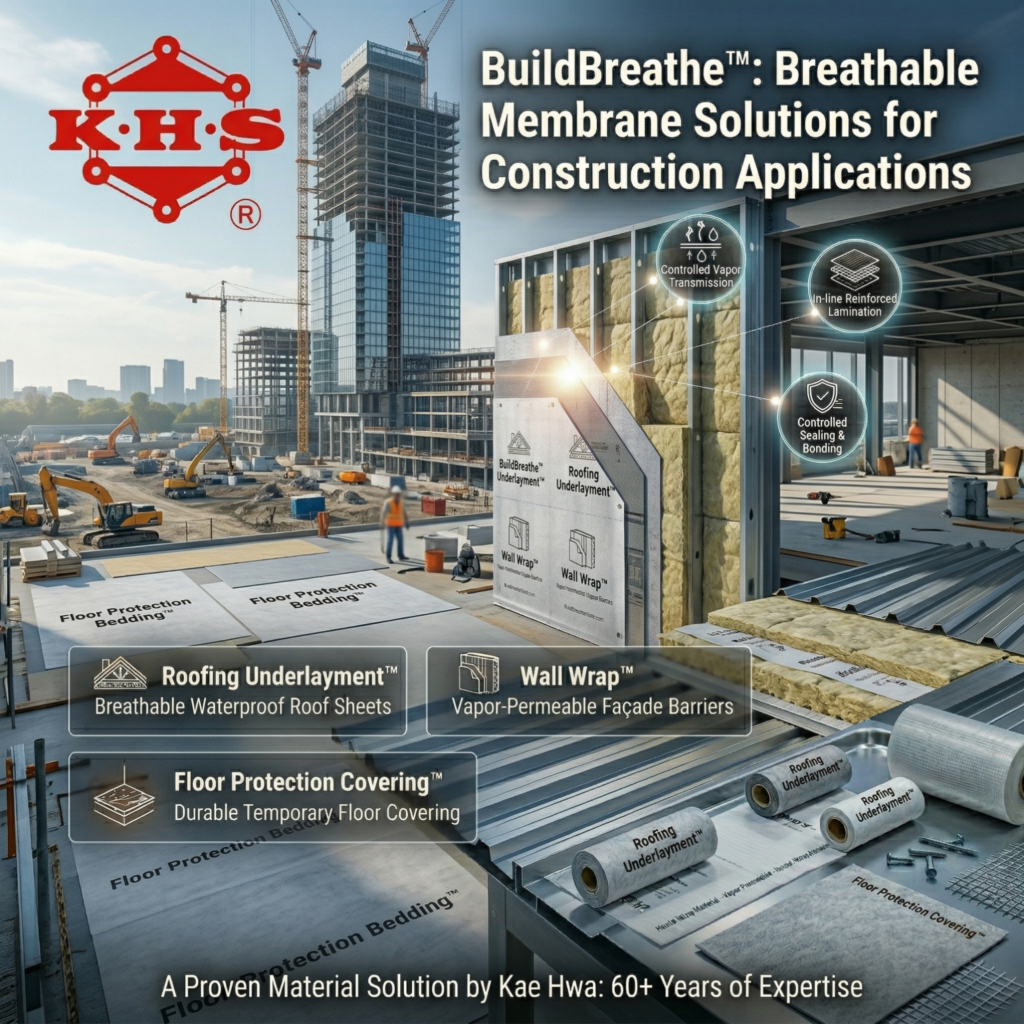
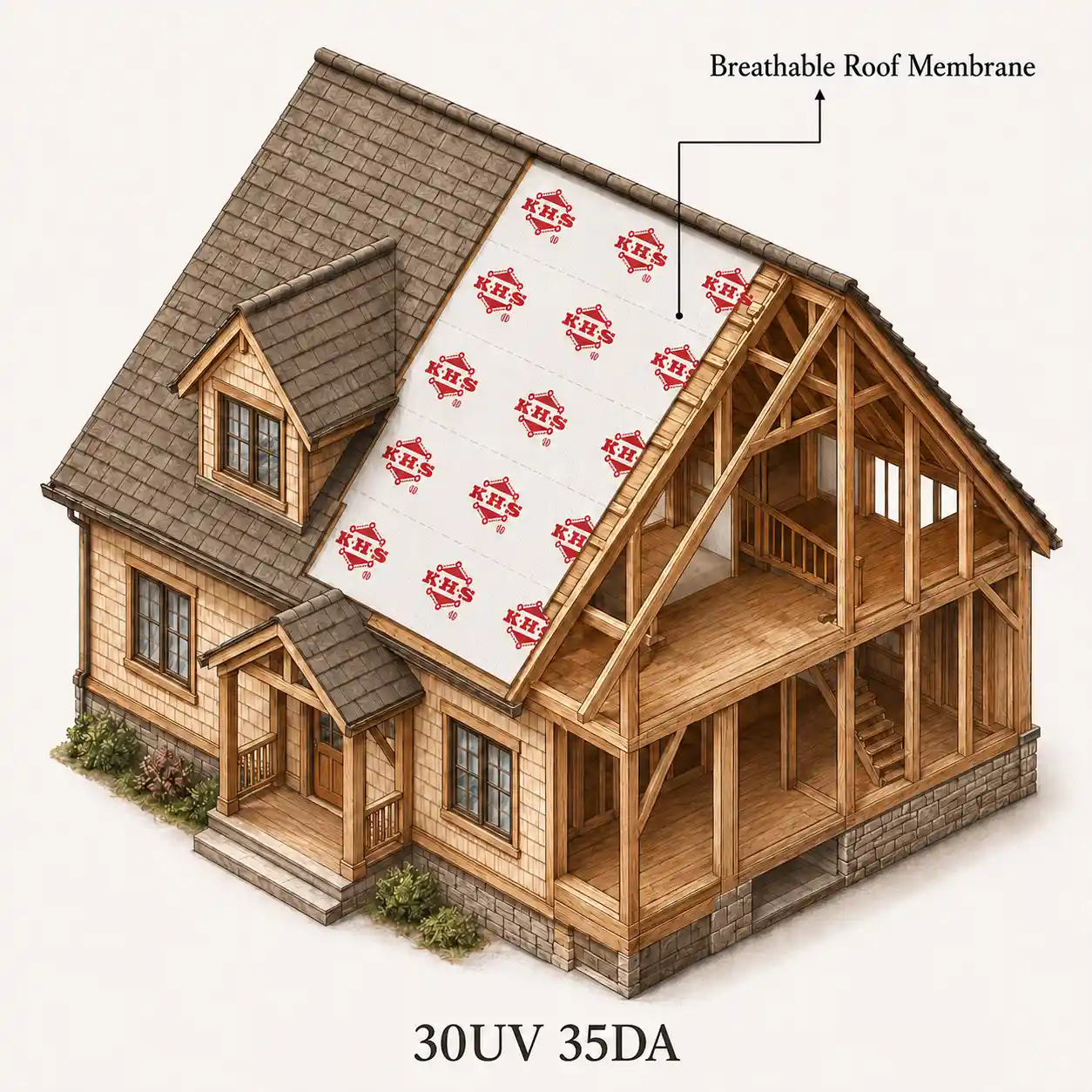
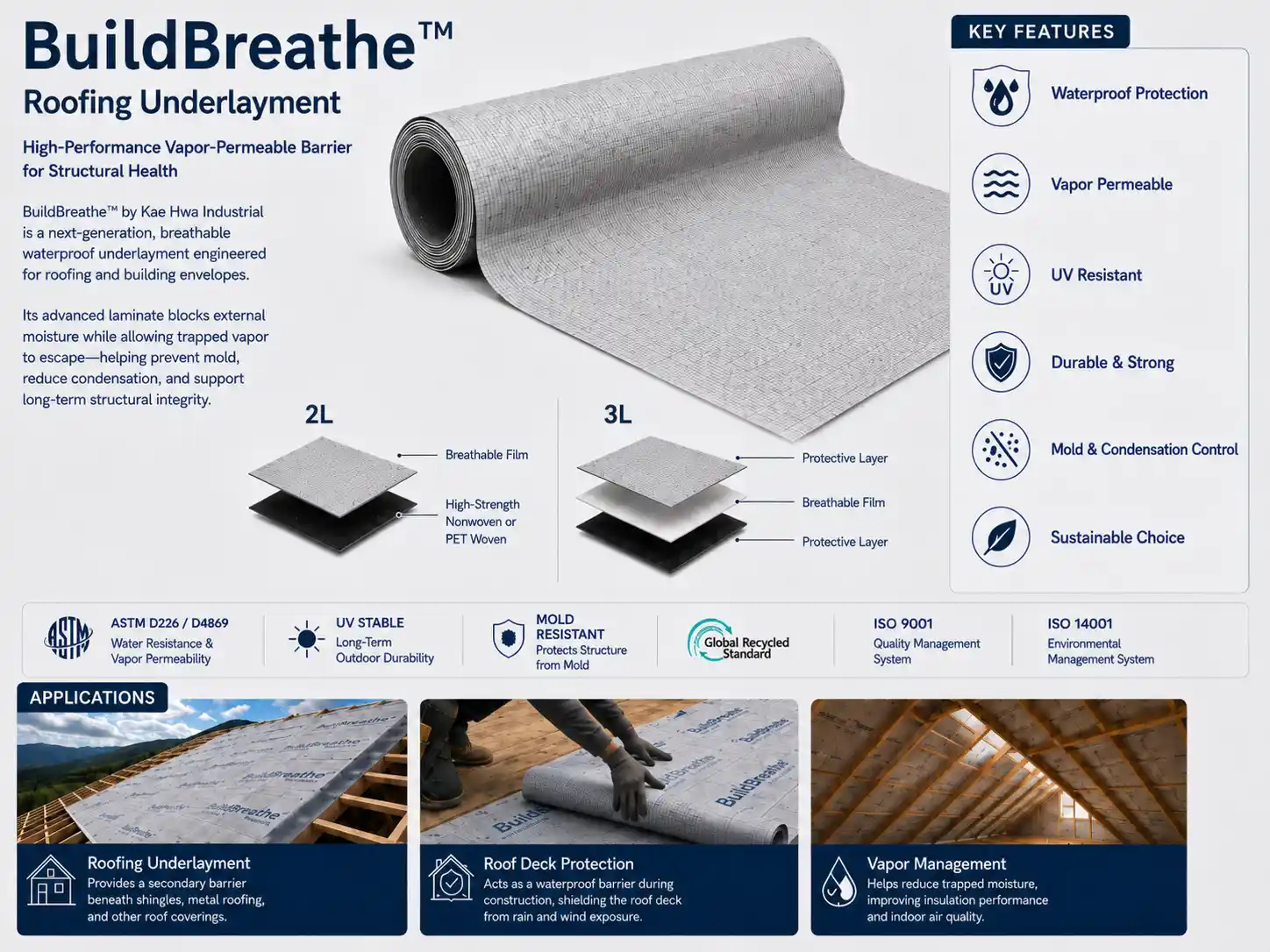
BuildBreathe™ by Kae Hwa Industrial offers a new generation of breathable waterproof membranes specifically engineered for roofing underlayment and building envelopes. These technical laminates utilize advanced microporous or monolithic film technology to block external rain and wind while allowing trapped moisture vapor to escape. By effectively reducing condensation and preventing mold growth, BuildBreathe™ ensures long-term structural integrity and energy efficiency for modern architecture.
Lightweight
Breathable
Waterproof
A “Breathing” Barrier That Protects the Roof Structure — Breathable Waterproof Roofing Membrane Design
In modern sustainable and energy-efficient architecture, the roof is not only the first line of defense against wind and rain. It is also a critical part of maintaining structural health and overall building energy efficiency.
Over years of service, however, many buildings may appear intact from the outside while their internal structures gradually deteriorate because of trapped moisture. Drawing on more than 60 years of experience in chemical materials and manufacturing, together with its long-established expertise in waterproof and breathable membrane development, Kae Hwa Industrial has introduced BuildBreathe™ Roofing Underlayment.
By combining advanced material engineering with composite manufacturing processes, BuildBreathe™ helps block external liquid water while allowing accumulated moisture vapor to escape from within the structure. It creates a protective roofing barrier that balances waterproofing, moisture release, and long-term durability.
The Hidden Risk Inside Roof Structures: Interstitial Condensation and Reduced Energy Efficiency
Many people assume that roof waterproofing simply means preventing visible water leakage. However, as buildings are exposed to changing climates and temperature differences, roof structures face risks not only from external rainwater but also from moisture accumulating within the building envelope.
During daily building use, water vapor is continuously generated in occupied spaces, attics, and upper-floor areas. As this vapor moves upward through air leakage or material diffusion, it may come into contact with timber roof frames, metal components, or insulation layers that have been cooled by low outdoor temperatures.
When this occurs, interstitial condensation may form between material layers.
This concealed moisture can lead to a series of problems:
When insulation materials absorb moisture, their thermal resistance, or R-value, may decline. As a result, heating, ventilation, and air-conditioning systems may consume more energy to maintain a comfortable indoor environment.
A roof structure that remains damp for extended periods can create favorable conditions for mold growth. Mold spores may then circulate into occupied spaces, affecting indoor environmental quality.
Modern buildings therefore require functional protective materials that can block external liquid water while providing a pathway for moisture vapor to escape. A breathable waterproof membrane serves as one component of a complete roof moisture-management system.
The BuildBreathe™ Dual-Protection Mechanism: Balancing Hydrostatic Resistance and Moisture Vapor Transmission
BuildBreathe™ breathable waterproof roofing membranes are developed to support both waterproofing and moisture-management requirements within modern roof assemblies.
Through engineered membrane and composite structures, BuildBreathe™ helps resist external liquid water while allowing moisture vapor within the roof system to diffuse outward. This supports the reduction of condensation and moisture-accumulation risks.
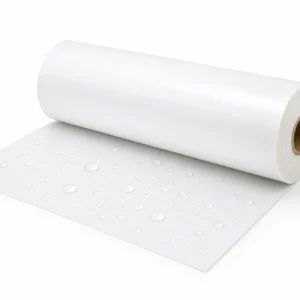
BuildBreathe™ provides reliable water resistance and hydrostatic pressure performance.
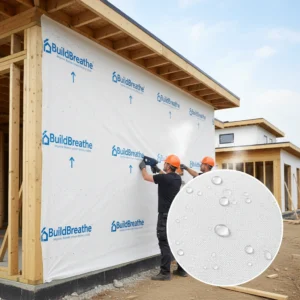
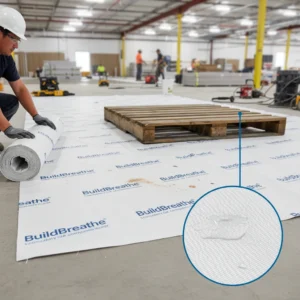
During both the construction stage and subsequent building use, the material helps resist water penetration caused by heavy rain, wind-driven rain, and melting snow. This reduces the risk of external moisture reaching the insulation layer or internal roof structure.
While providing resistance to liquid water, BuildBreathe™ can also be engineered with an appropriate moisture vapor transmission rate, or MVTR, according to the selected membrane formulation and structural design.
Moisture vapor accumulated within the roof assembly can diffuse through the membrane toward the exterior, helping the insulation, timber framing, and roof cavity maintain a more stable and comparatively dry condition.
A breathable roofing membrane should not be viewed as a standalone solution for every condensation issue. It functions as part of a complete roof moisture-management system and should be combined with appropriate insulation, airtightness, vapor-control, and ventilation design.
To meet different climate conditions, roofing structures, and performance requirements, Kae Hwa Industrial offers two breathable membrane technology pathways.
Microporous Film
Microporous films are produced through precisely controlled material formulations and physical stretching processes that create fine pores within the membrane structure.
These pores allow moisture vapor and certain gases to pass through, while the pore structure and surface properties of the material help resist the penetration of liquid water. This creates a physical barrier that balances breathability and waterproof protection.
Microporous technology can be customized according to product requirements, including film weight, pore structure, moisture vapor transmission, and hydrostatic resistance. It is suitable for a wide range of construction barriers and composite materials.
Monolithic Hydrophilic Film, Including AquaVene™ Technology
Monolithic hydrophilic films use hydrophilic polymer technology. Rather than relying on physical pores, the membrane transports moisture vapor through hydrophilic molecular chains.
Moisture vapor molecules are first absorbed by the surface of the membrane, then diffuse through the polymer chains before being desorbed and released from the opposite side. This creates an absorption, diffusion, and desorption transmission process.
Because the monolithic structure does not depend on physical micropores, it can reduce the risks associated with pore contamination caused by oils, surfactants, or surface wetting. Mechanical properties can be engineered according to the polymer formulation and composite structure.
Protection Against Sunlight and High Temperatures: UV- and Thermal-Stabilized Formulations
The roof is one of the most demanding areas of a building, with frequent exposure to sunlight and significant temperature fluctuations.
During installation, roofing underlayment may be directly exposed to sunlight and outdoor conditions. After construction, temperatures beneath roofing tiles or metal panels may also rise because of solar heat.
Roofing membranes must therefore provide not only waterproof and breathable performance but also suitable weather resistance.
Depending on product requirements, BuildBreathe™ can incorporate ultraviolet stabilizers and thermal stabilizers into its material formulation.
UV- and thermal-stabilized formulations can improve material durability during construction exposure and under elevated roof temperatures. They help delay aging, yellowing, and the deterioration of physical properties.
Actual weather resistance and allowable exposure periods should be confirmed according to the product grade, material structure, testing conditions, and construction environment.
Films produced through controlled material formulations and processing conditions can maintain more stable dimensions and surface flatness under changing temperatures.
Good dimensional stability helps reduce warping, tearing, and wrinkling caused by thermal expansion and contraction. It also supports more consistent installation around roof edges, drainage areas, and roof-to-wall intersections.
Advanced Manufacturing: ±0.01 mm Precision Control and Reinforced Composite Structures
Consistent protection begins with precise control of film thickness, lamination conditions, and composite construction.
The core functional film used in each BuildBreathe™ roll can be manufactured using Kae Hwa Industrial’s precision casting film technology, with film thickness tolerance controlled within ±0.01 mm.
Consistent thickness control helps reduce performance variation caused by uneven film formation. It improves the consistency of moisture vapor transmission and hydrostatic resistance throughout the roll while reducing the possibility of localized weak points affecting final product performance.
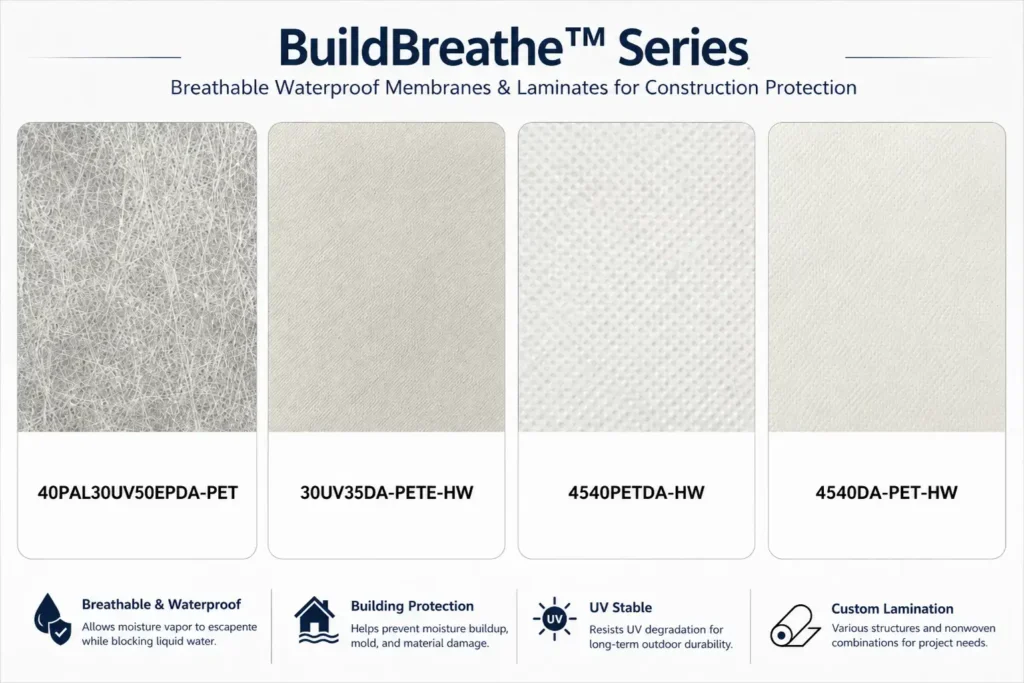
To withstand mechanical stresses such as walking, pulling, fastening, handling, and contact with installation tools, BuildBreathe™ can combine functional membranes with high-strength PP or PET nonwovens and technical textiles.
The multilayer structure can be engineered to improve tear resistance, puncture resistance, and dimensional stability according to application requirements. It also helps reduce the risk of damage caused by pulling, abrasion, or localized mechanical stress during installation.
Depending on the required product structure, Kae Hwa Industrial can apply precision adhesive coating and solvent-free lamination processes to securely bond functional membranes with PP or PET nonwovens and technical textiles.
Through precise control of adhesive application, web tension, and processing conditions, the composite structure maintains its waterproof and breathable performance while improving tear resistance, puncture resistance, and converting stability.
In line with its commitment to environmental sustainability, Kae Hwa Industrial uses environmentally responsible, solvent-free lamination technology that does not release harmful volatile organic compounds. The process fully complies with modern green building assessment standards, such as LEED, and is supported by GRS certification and the ISO 14001 environmental management system.
Creating Reliable, Invisible Protection for Building Projects
As the construction industry places greater emphasis on energy efficiency, carbon reduction, structural durability, and indoor environmental quality, roof moisture management has become an essential consideration in modern building design.
An effective breathable waterproof roofing membrane should not only resist external rainwater but also provide a pathway for internal moisture vapor to diffuse outward. As part of a complete roof moisture-management system, it helps reduce the risks associated with condensation and moisture accumulation.
With its manufacturing base in Taiwan and extensive global service experience, Kae Hwa Industrial provides customized membrane and lamination solutions for building-material brands, material converters, and engineering supply chains.
Kae Hwa’s products serve global markets and are supported by international cooperation experience across a wide range of industries.
BuildBreathe™ is more than a layer of roofing material. It represents Kae Hwa Industrial’s approach to Engineering Invisible Safety.
Through reliable waterproof performance, controlled moisture vapor transmission, weather-resistant formulations, and reinforced composite structures, BuildBreathe™ helps roof systems release accumulated moisture vapor and reduce the possibility of condensation, mold growth, and structural moisture damage.
It establishes a dependable protective foundation for the long-term stability and durability of modern buildings.
Redefining the Boundaries of Breathable Technology
Why Choose Kae Hwa
With over 60 years of expertise in polymer science and functional membranes, Kae Hwa Industrial is a global leader in "Engineering Invisible Safety". Our BuildBreathe™ series represents our commitment to sustainable construction, providing materials that are non-toxic, recyclable, and trusted by building material brands in over 100 countries.
We deliver:
Precision-engineered membranes with ±0.01 mm tolerance.
Solvent-free lamination for cleaner, more durable composites.
Global supply stability from production bases in Taiwan and Malaysia.
It creates a weather-resistant barrier that blocks liquid water and wind while allowing trapped moisture vapor to escape. This precise moisture management prevents condensation and mold growth, ensuring long-term structural longevity.
Our precision casting technology maintains a consistent ±0.01 mm thickness tolerance to ensure uniform performance across the entire membrane. This eliminates defects and creates a stable pore structure for predictable moisture vapor transmission rates (MVTR).
Microporous films utilize a physical pore structure to allow air and vapor through while blocking liquids. In contrast, Monolithic films (AquaVene™) are non-porous and rely on hydrophilic polymer chemistry to disperse water vapor molecules via molecular diffusion.
Yes, the membrane is engineered with specific UV and thermal stabilizers to maintain dimensional stability under extreme outdoor conditions. It provides a durable, weather-resistant barrier that remains effective during demanding construction phases.
Kae Hwa utilizes a solvent-free in-line lamination process to minimize VOC emissions and energy consumption. Our commitment is backed by GRS certification for recycled content and ISO 14001 carbon verification.