
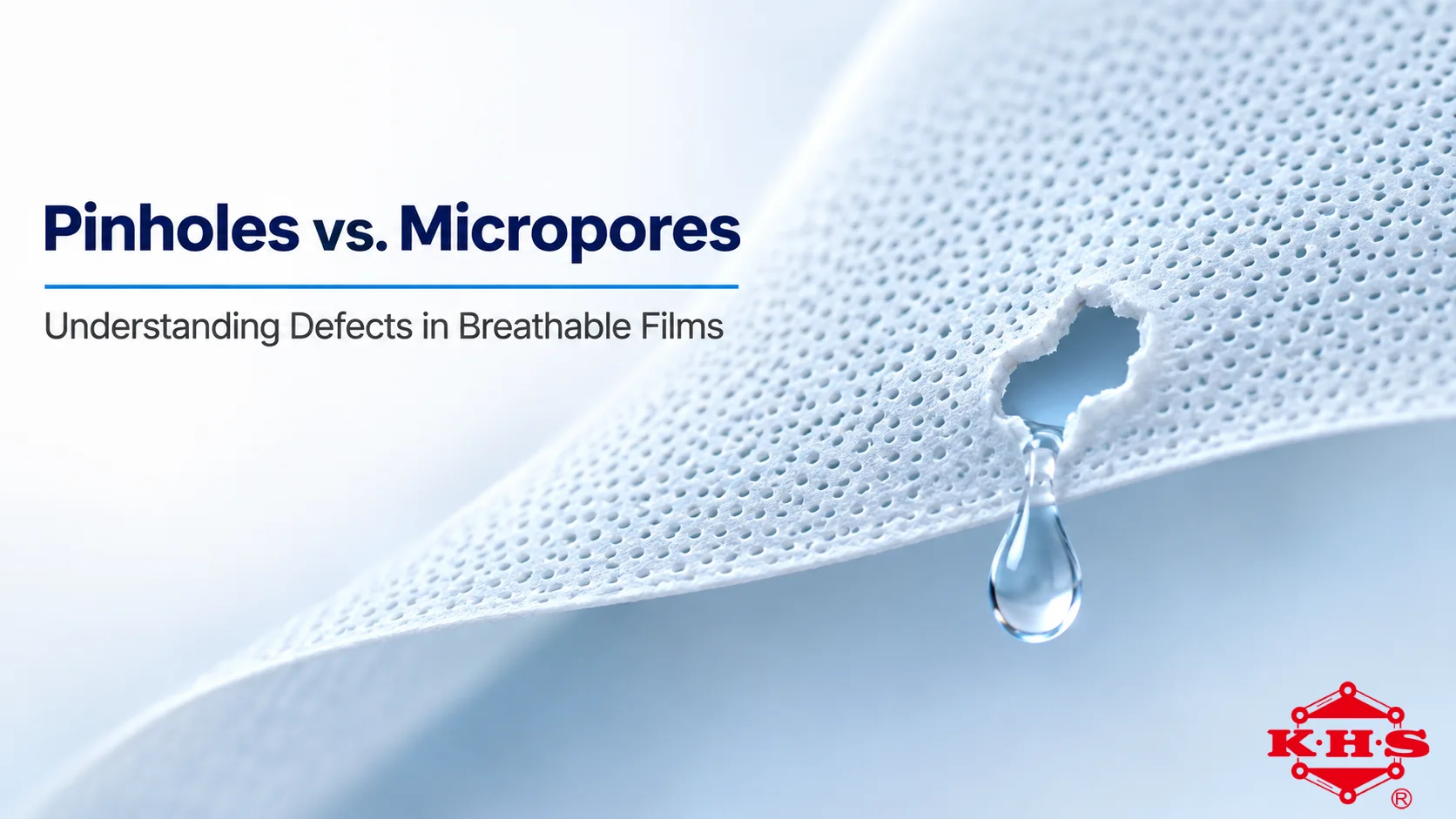
Breathable films are designed to let moisture vapor pass through while resisting liquid water penetration. In microporous membranes, this performance depends on an engineered network of extremely small pores.
When comparing pinholes vs. micropores, it is important to remember that not every opening in a polymer film serves the same purpose.
During film manufacturing and downstream processing, unintended openings can also develop. These are commonly described as pinholes, and they may create localized weaknesses in an otherwise functional waterproof barrier.
For manufacturers using breathable films in hygiene products, protective clothing, construction membranes, and technical laminates, understanding pinholes vs. micropores is essential.
The critical difference is not simply whether a film contains holes. It is whether those openings belong to the intended membrane structure and maintain the required barrier performance.
Key Takeaways
- Pinholes in breathable films are unintended openings that may create localized leakage pathways, while micropores are an engineered structure designed for moisture vapor transmission.
- A good average WVTR does not prove uniform barrier integrity, because WVTR is not a direct measurement of pinhole defects.
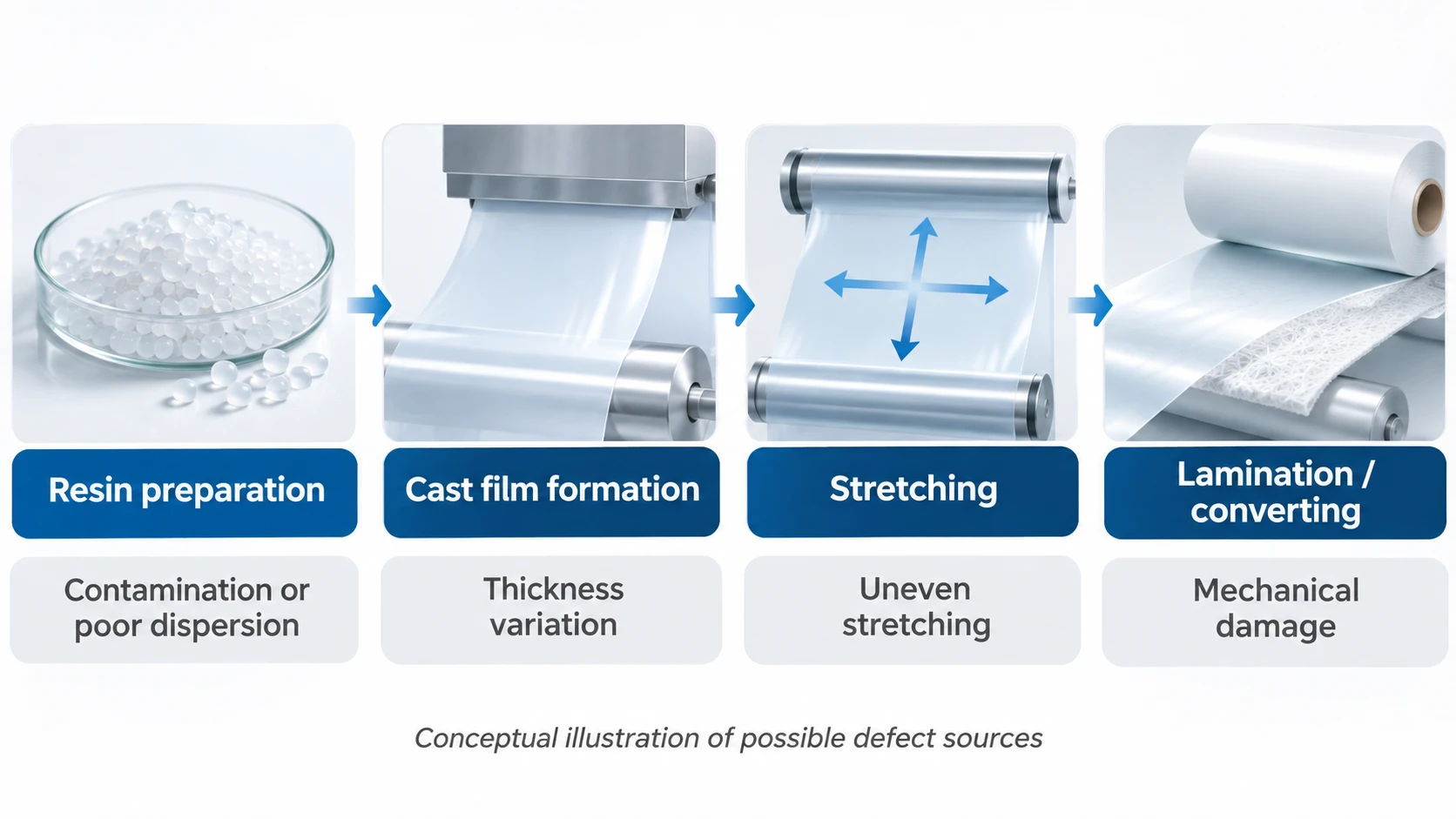
- Pinholes can originate at several stages: raw material contamination, thickness variation, uneven stretching, and mechanical damage during converting and lamination.
- Detection combines visual and optical inspection, microscopy, hydrostatic pressure testing, and testing of the finished laminate; no single method is sufficient on its own.
Pinholes vs. Micropores: Two Very Different Structures
At first glance, micropores and pinholes may appear to describe the same thing: small openings in a thin polymer film.
From a material engineering perspective, however, they have different origins and functions.
Micropores: Engineered for Moisture Transmission
Micropores are intentionally developed within a breathable membrane through controlled material formulation and processing.
In polyethylene (PE) and polypropylene (PP) breathable films, the pore network allows moisture vapor to move through the membrane while providing resistance to liquid water penetration under specified conditions.
The effectiveness of this structure depends on several interconnected factors:
- Pore size, distribution, and connectivity
- Polymer composition and surface properties
- Film thickness and structural uniformity
- Stretching conditions and mechanical stability
These characteristics determine how effectively the membrane balances moisture transmission with waterproof resistance.
Related Knowledge Center FAQ: How Are Micropores Formed in PP Breathable Film? Filler-Free PP vs. Calcium Carbonate-Filled PP
Pinholes: Unintended Openings in the Film
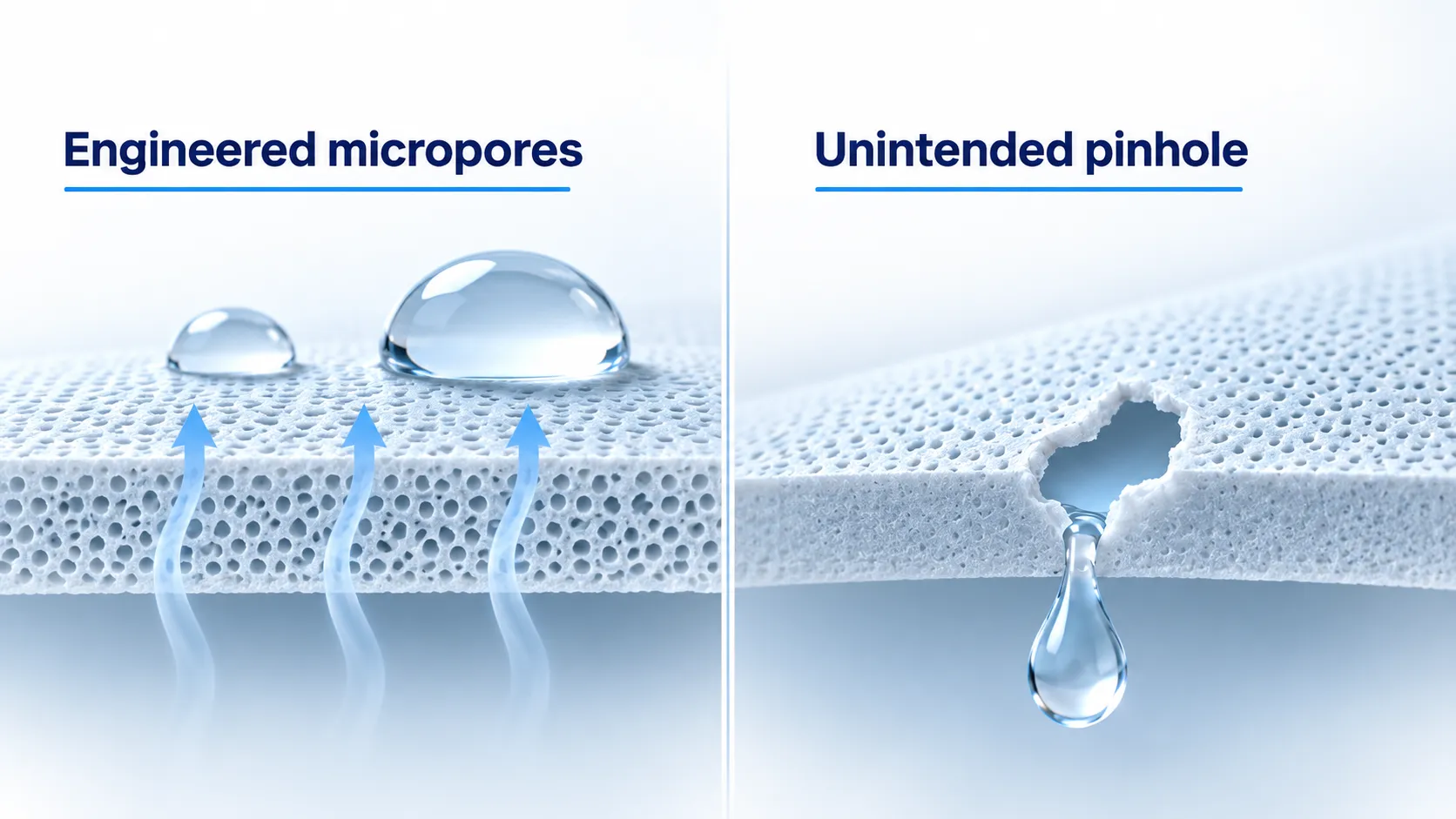
A pinhole is an unintended opening or localized discontinuity that may compromise the film’s intended barrier function.
Unlike engineered micropores, pinholes are not part of the controlled structure designed to deliver the specified performance.
They may develop when a local area becomes excessively thin, a particle disrupts film formation, or mechanical stress damages the membrane during processing.
Not every visible irregularity is necessarily a pinhole. For example, a gel or contaminant embedded in the film may cause optical distortion without creating a complete opening through the material.
However, certain defects can create weak regions that eventually develop into holes during stretching, lamination, or handling.
The result is a potential leakage pathway that behaves differently from the surrounding microporous structure.
| Characteristic | Engineered micropores | Unintended pinholes |
|---|---|---|
| Formation | Controlled membrane manufacturing | Localized processing or material defect |
| Distribution | Designed pore network | Irregular or localized occurrence |
| Intended function | Moisture vapor transmission | No intended functional role |
| Liquid resistance | Designed for a specified pressure range | May reduce local barrier resistance |
| Quality evaluation | Pore structure and performance testing | Defect identification and barrier integrity testing |
There is no universal diameter at which a micropore automatically becomes a pinhole. The distinction must be evaluated in the context of the membrane design, its manufacturing process, and its required performance.
Why Can a Small Pinhole Affect Waterproof Performance?
Waterproof performance is not determined only by the average structure of a membrane.
It also depends on whether the film contains localized pathways through which liquid water can penetrate under the conditions of use.
A properly engineered microporous film resists liquid penetration through a combination of pore geometry, polymer surface properties, and capillary effects.
Liquid entry becomes more likely when the applied pressure exceeds the resistance of a particular pathway. Surface wetting conditions and liquid surface tension also influence this behavior.
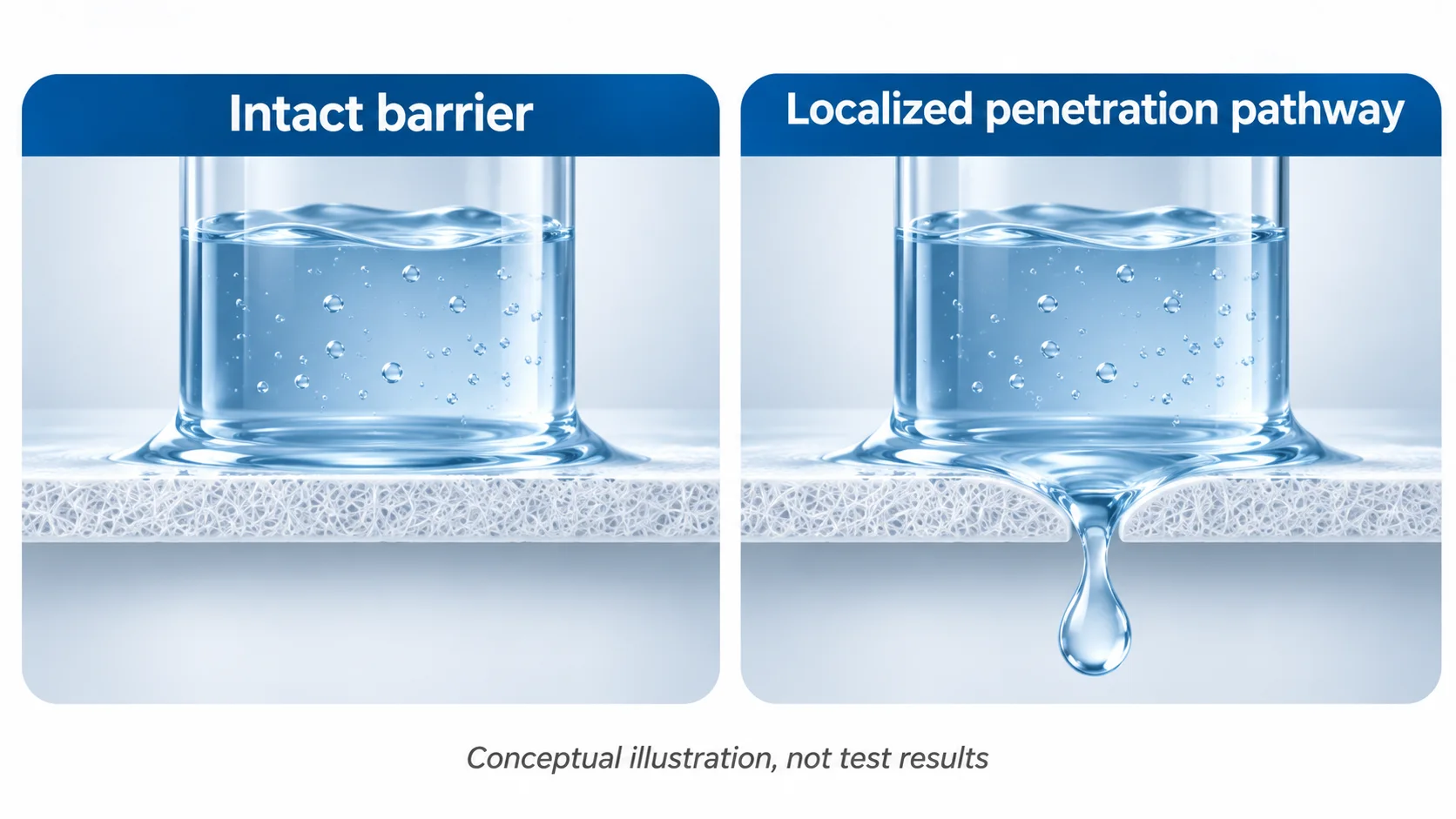
An unintended pinhole may create a more direct or less resistant pathway than the surrounding membrane structure.
This introduces a practical problem.
A film can exhibit relatively consistent thickness and moisture vapor transmission across most of its surface while still containing a small area with reduced liquid resistance.
When exposed to water pressure, that local region may become the first point of penetration.
This is why a good average performance value does not necessarily establish uniform barrier integrity across an entire film roll.
Why WVTR Alone Cannot Identify Pinholes
Water Vapor Transmission Rate (WVTR) measures the quantity of water vapor passing through a material under defined testing conditions. For a deeper look at the factors behind this value, see What Affects Breathable Film WVTR.
It is an important parameter for breathable film performance, but it is not a direct measurement of pinhole defects.
A higher WVTR value may result from an intentionally designed pore network, changes in polymer chemistry, differences in thickness, or testing conditions.
It should not automatically be interpreted as evidence of leakage.
Likewise, a film with acceptable WVTR may still contain localized defects that require separate investigation.
Moisture vapor transmission and liquid barrier integrity must therefore be evaluated as different performance characteristics.
Where Do Pinholes Come From During Film Manufacturing?
Pinholes do not necessarily originate from a single manufacturing problem.
Their formation can involve material conditions, film formation, stretching, and downstream converting.
Understanding when a defect develops is often more useful than examining its final appearance alone.
1. Raw Material Contamination and Poor Dispersion
Polymer films require consistent material preparation before extrusion.
Unmelted resin particles, degraded polymer, foreign contaminants, or poorly dispersed additives may create localized irregularities within the film.
These irregularities are sometimes called gels or fish eyes.
A gel does not automatically mean a hole is present. However, it may produce a region with different mechanical properties from the surrounding polymer.
When the film is subsequently stretched or placed under tension, that region may deform unevenly and become a potential point of failure.
Controlling raw material quality, melt filtration, and material dispersion is therefore important for film consistency.
2. Localized Thickness Variation During Film Formation
During film extrusion, molten polymer must be distributed consistently across the intended film width.
Variations in melt flow, die conditions, cooling, or line speed can contribute to uneven thickness.
A locally thinner region may behave differently under mechanical loading than the surrounding film.
This does not mean every thin region will develop a pinhole.
However, when localized thinning combines with excessive tension or a material irregularity, the probability of rupture may increase.
Thickness uniformity should therefore be considered alongside mechanical strength and barrier performance.
3. Excessive or Uneven Stretching
Stretching plays an important role in the production of many microporous breathable films.
The process creates the pore network required for moisture transmission.
However, film deformation must remain compatible with the selected polymer formulation and intended structure.
If local stress exceeds the material’s capacity to deform uniformly, certain regions may develop excessive void growth, tearing, or other structural discontinuities.
This is especially important for lightweight films, where the available material thickness may leave less tolerance for localized defects or abnormal stresses.
The manufacturing objective is not simply to generate more pores.
It is to develop a controlled structure that delivers the required breathability without sacrificing mechanical stability or liquid resistance.
4. Mechanical Damage During Converting and Lamination
A film may leave the extrusion process with acceptable properties and still experience damage during later processing.
Potential sources of mechanical stress include:
- Excessive web tension during unwinding or rewinding
- Contact with damaged or abrasive equipment surfaces
- Localized pressure during bonding
- Inconsistent lamination conditions that create localized mechanical stress
- Handling, folding, or converting operations that exceed the material’s mechanical limits
Lamination introduces additional variables because the membrane interacts with another material, such as a nonwoven or woven textile.
Web tension, localized pressure, lamination conditions, and differences in material deformation may all influence the final composite.
For this reason, film integrity must be considered both before and after lamination.
How Can Manufacturers Detect Pinholes in Breathable Films?
Identifying a possible pinhole is only the first step.
The more important task is determining whether the observed irregularity represents a genuine opening, a cosmetic defect, or a localized weakness that affects the intended application.
Different inspection methods answer different questions.
Visual and Optical Inspection
Backlighting and optical inspection can help reveal visible holes, surface irregularities, gels, scratches, and other discontinuities.
These methods are useful for locating suspect regions and observing patterns across the film width or production direction.
However, small defects may not be visible under ordinary inspection conditions.
A visual inspection result alone should not be treated as complete verification of waterproof integrity.
Microscopic Examination
Microscopy provides a closer view of localized film structure.
It can help investigate irregularities that are too small for direct visual identification and distinguish surface features from suspected openings.
Depending on the analysis method, microscopic examination may help characterize pore morphology, local deformation, or defects associated with particles and film rupture.
Nevertheless, a microscopic image alone does not always establish the material’s performance under liquid pressure.
Structural examination and functional testing should complement one another.
Hydrostatic Pressure Testing
Hydrostatic pressure testing evaluates a material’s resistance to water penetration under increasing pressure.
Methods such as ISO 811 and AATCC TM127 are commonly used for applicable textile and laminated fabric constructions.
These tests provide a more direct assessment of liquid water resistance than WVTR measurements.
Unexpectedly low hydrostatic pressure results may indicate weaknesses in the barrier structure, but they do not identify the cause on their own.
Potential explanations include pore structure, wetting behavior, mechanical damage, or localized film defects.
A failed result should therefore lead to further examination rather than an immediate assumption that pinholes are responsible.
Why Finished Laminate Testing Matters
For a film intended for lamination, testing only the original membrane may not represent the performance of the finished product.
Lamination and subsequent handling may introduce mechanical stress, while the selected substrate may change the mechanical behavior of the material.
A practical evaluation should consider whether barrier performance remains acceptable after the film has undergone the intended converting process.
For medical protective materials, application-specific evaluations may also be required. For example, ASTM F1671/F1671M addresses resistance to blood-borne pathogen penetration under specified test conditions.
Passing a hydrostatic pressure test alone is not equivalent to demonstrating viral barrier performance.
From a Defect to Its Root Cause
When a breathable film exhibits unexpected liquid penetration, the first question should not be whether the entire formulation is defective.
Instead, manufacturers should determine where the loss of barrier integrity occurs and under what conditions.
A useful investigation can begin with several observations.
Is the issue localized or widespread?
A single leakage point suggests a different investigation from a consistent reduction in waterproof resistance across multiple specimens.
Does the defect repeat in the machine direction?
Repeated defects at similar positions may point toward equipment contact, die-related conditions, or another recurring process influence.
Was the defect present before lamination?
Comparing retained film samples with finished laminates can help narrow down when the issue first appeared.
Do affected specimens show other structural abnormalities?
Thickness variation, gels, scratches, or signs of local deformation may provide useful clues, although these observations do not establish causation on their own.
The aim is to distinguish a localized manufacturing defect from a broader material-performance issue.
This distinction matters because the corrective action may involve a different part of the process.
Changing the polymer formulation is not necessarily the appropriate response to damage caused during converting. Similarly, adjusting lamination pressure may not resolve a defect originating from contaminated resin.
Effective troubleshooting begins by identifying the stage at which the abnormality first develops.
Why Barrier Integrity Matters Across Different Applications
The consequences of an unintended opening depend on how the breathable film is used.
In hygiene backsheets, localized liquid penetration can affect leakage protection, even when the surrounding material remains breathable.
In medical and protective laminates, barrier integrity must be evaluated against the specific exposure conditions and relevant performance requirements. Visual appearance or general waterproof claims are not sufficient evidence of protection against biological hazards.
In construction membranes, unexpected liquid pathways may reduce protection against rainwater entering the building envelope.
For outdoor functional laminates, localized barrier weakness can become noticeable when the material is exposed to prolonged rain, flexing, or mechanical pressure.
Across these applications, the central principle remains the same:
A breathable film must not only achieve its target performance under laboratory conditions. It must also maintain that performance through manufacturing, converting, and its intended use.
Engineering Consistent Breathable Films at Kae Hwa
Kae Hwa Industrial develops microporous PE and PP membranes through its MicroBreath™ film technology.
The manufacturing approach combines material formulation, controlled film formation, and process management to support the balance between moisture vapor transmission, waterproof resistance, and mechanical stability.
Kae Hwa also provides customizable laminated material solutions for applications requiring combinations of breathable films and selected substrates.
Because lamination creates a composite structure, the properties of the finished material may differ from those of the original film.
Therefore, the finished laminate should be tested to confirm that it meets the intended application’s requirements.
For customers developing hygiene, medical, industrial, or technical textile products, film selection should therefore be based on more than a single performance figure.
Material structure, thickness consistency, processing conditions, and application-specific testing all contribute to the reliability of the finished product.
Looking for a Breathable Film for Your Application?
Kae Hwa Industrial provides PE and PP breathable membranes and customized laminated material solutions for hygiene, medical, industrial, and other technical applications.
Explore MicroBreath™ PE and MicroBreath™ Pure (PP Filler-Free) films, or contact Kae Hwa to discuss material specifications, processing requirements, and application-specific testing.