
 Disposable hygiene laminate materials are deceptively complex.
A diaper backsheet, sanitary napkin layer, training-pants laminate, or incontinence-care material may appear to be little more than a thin film combined with nonwoven fabric. In practice, however, that structure must perform several functions at the same time.
It must resist liquid leakage without feeling stiff. It must remain mechanically stable while being converted at high speed. It must allow moisture vapor to escape without weakening the barrier. And because the material may remain close to the skin for extended periods, softness, flexibility, and low noise are not simply aesthetic qualities — they are part of the functional design.
This is why modern hygiene materials cannot be evaluated only by asking whether a film is “waterproof” or “breathable.”
The more important question is:
Can the complete laminate maintain softness, breathability, barrier protection, and structural integrity at the same time?
For hygiene applications, achieving that balance requires careful control of the film structure, polymer formulation, basis weight, lamination system, and downstream processing conditions.
The Paradox of Softness and Strength
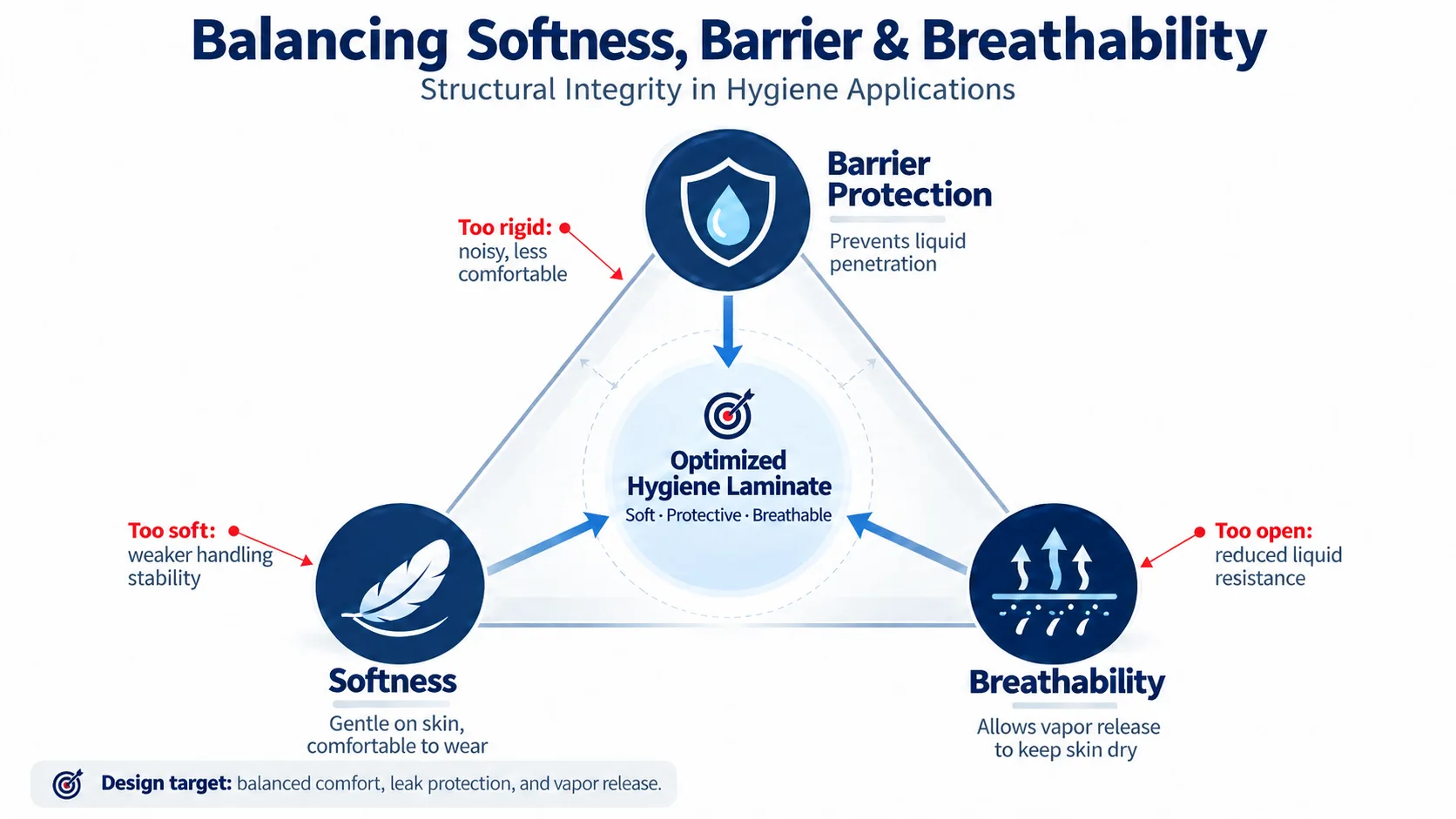
One of the central engineering challenges in disposable hygiene products is that many desirable properties naturally pull the material in different directions.
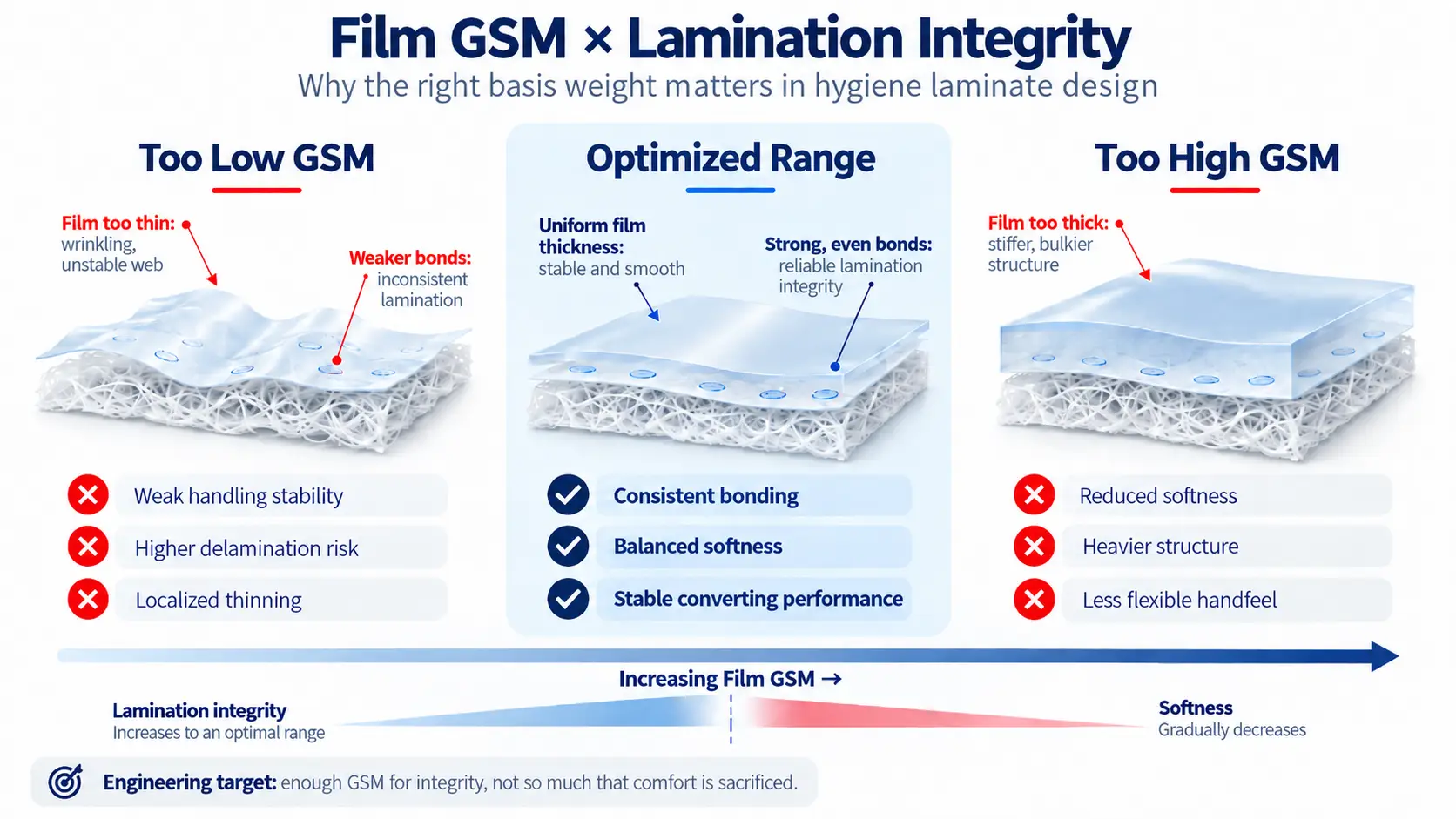
A thicker or more rigid film may improve handling stability, but it can also increase stiffness and noise.
A lighter film may improve softness and reduce material consumption, but reducing material excessively can make the film more sensitive to stretching, localized thinning, or damage during converting.
Similarly, a very soft nonwoven may improve tactile comfort, but if its structure does not interact properly with the film and adhesive system, the finished laminate may suffer from weak bonding or uneven mechanical performance.
This creates a basic design tension:
The laminate must be soft enough for skin-contact applications but strong enough to survive manufacturing and use.
In products such as baby diapers, adult incontinence products, and training pants, the backsheet experiences repeated bending, folding, stretching, compression, and contact with other components.
The material therefore cannot be designed around softness alone.
It must maintain sufficient dimensional and mechanical stability throughout:
- unwinding and tension control,
- printing and converting,
- adhesive application,
- cutting and sealing,
- product assembly,
- packaging compression,
- and final use.
The result is a material system in which softness and structural integrity must be engineered together rather than treated as opposing objectives.
What Does Structural Integrity Mean in a Hygiene Laminate?
Structural integrity does not refer to a single test value.
For a hygiene laminate, it describes the ability of the complete material system to maintain its intended structure and barrier function during processing and use.
This includes several related properties.
Film Continuity
The breathable film must remain continuous enough to prevent unintended liquid penetration.
Microporous films contain engineered micro-scale pathways for vapor transport, but those structures must remain controlled. Excessive stretching, localized thinning, or processing damage can alter the relationship between breathability and liquid resistance.
Mechanical Stability
The film and laminate must tolerate machine-direction and cross-direction stresses without excessive tearing, elongation, or deformation.
Stable mechanical behavior becomes particularly important on high-speed converting lines, where lightweight materials are exposed to continuous tension.
Lamination Integrity
The nonwoven and film layers must remain bonded during converting and product use.
Good lamination is not simply about maximizing adhesive strength. Excessive bonding can make the composite rigid, while insufficient bonding may create delamination or unstable handling.
The goal is therefore controlled bonding strength with sufficient flexibility.
Barrier Consistency
A backsheet must provide dependable liquid resistance across the usable width and length of the roll.
The practical challenge is not achieving barrier performance at one laboratory test point. It is maintaining predictable performance across large-scale roll production.
Micro-Engineering for Skin Wellness
Breathability plays an important role in modern hygiene material design because moisture does not exist only as liquid.
Heat and humidity can accumulate inside a diaper, sanitary product, or incontinence-care system even when no visible liquid leakage occurs.
For this reason, breathable backsheets are designed to provide a pathway for moisture vapor while continuing to resist liquid penetration.
Kae Hwa’s microporous film technology uses engineered micro-scale structures that allow vapor and air transport while maintaining resistance to liquid water.
This principle becomes particularly useful in hygiene laminates.
Instead of creating a completely sealed polymer layer, a microporous PE film can help manage the microclimate between the product and the wearer by allowing accumulated vapor to move outward.
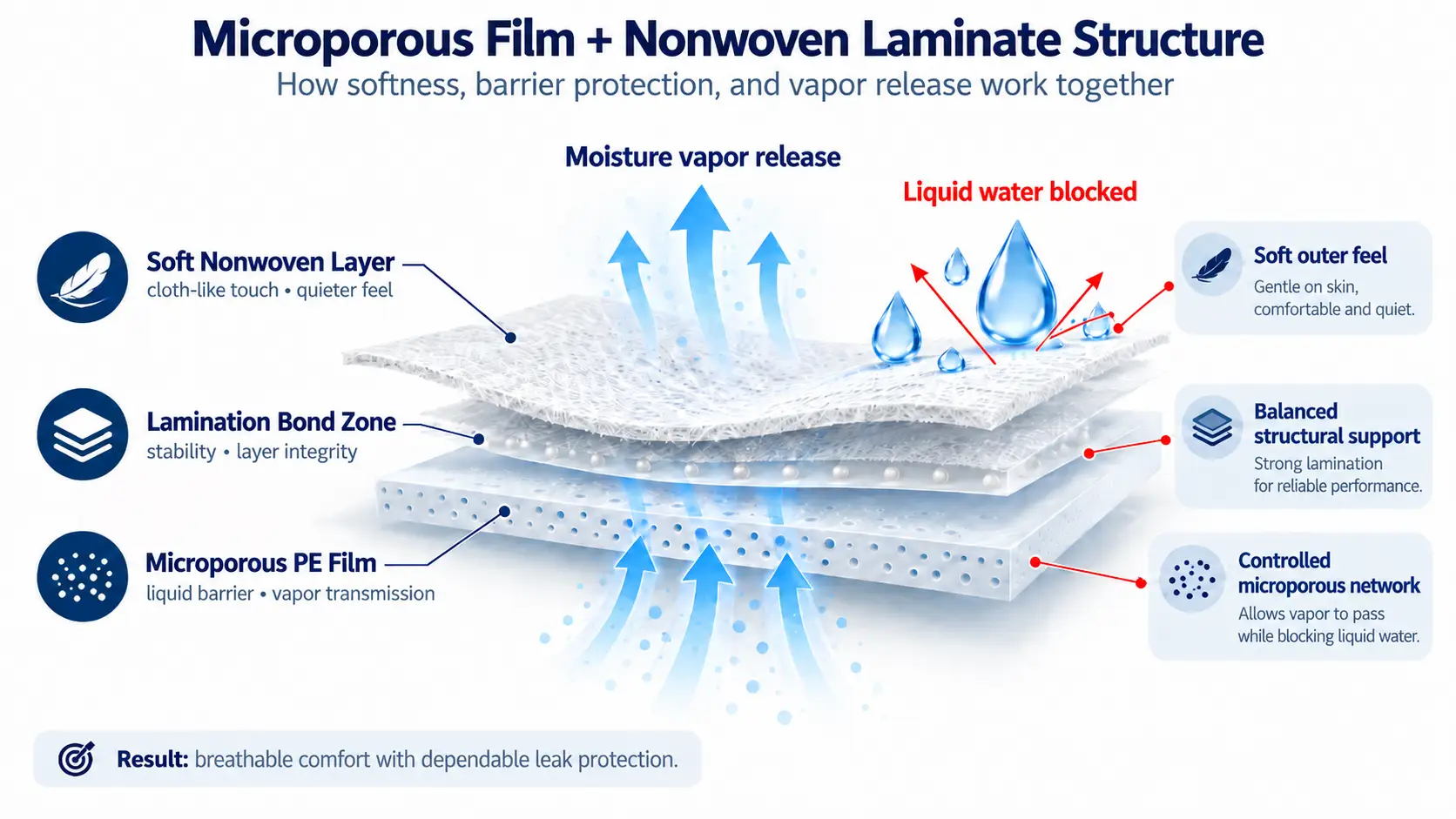
When laminated with a suitable nonwoven layer, the structure can combine:
Liquid resistance
The film acts as the primary barrier against leakage.
Moisture-vapor transmission
The microporous structure allows moisture vapor to move through the material.
Soft tactile contact
The nonwoven layer creates a more textile-like outer surface.
Mechanical reinforcement
The combined structure can improve handling and converting stability compared with an unsupported lightweight film.
This film-and-nonwoven combination forms the basis of many modern breathable hygiene backsheets.
Kae Hwa’s HygieSoft™ platform, for example, is designed around breathable films and laminated structures for applications including diapers, sanitary pads, and nursing-care products, with emphasis on softness, leak protection, and skin comfort.
 Why Microporous Structure Requires Precise Control
The word “microporous” can make breathable film sound simple: create small pores and vapor can pass through.
In manufacturing, the relationship is much more sensitive.
Breathability depends on how polymer composition, mineral filler, stretching conditions, film thickness, pore formation, and pore distribution interact.
Changing one parameter can influence several properties simultaneously.
For example, increasing pore development may improve moisture-vapor transport, but uncontrolled pore formation could also reduce mechanical stability or liquid resistance.
Increasing film thickness may improve certain mechanical characteristics but can change handfeel, flexibility, material consumption, and moisture transmission.
This is why the objective is not to maximize pore quantity.
It is to produce a controlled microporous network that delivers the intended relationship between vapor transmission, waterproof resistance, and mechanical integrity.
For hygiene products manufactured in very large volumes, this consistency becomes especially important. A material that performs well only under ideal laboratory conditions is not sufficient; the roll must remain predictable throughout converting.
Process Precision: Why Casting Film Technology Matters
Material performance begins before lamination.
The physical characteristics of the film are established during extrusion and film formation, which means that thickness uniformity, surface quality, polymer orientation, and thermal history can influence the finished laminate.
Precision casting technology is particularly valuable for hygiene applications because it allows manufacturers to produce thin films with controlled thickness and a smooth surface.
Kae Hwa’s HygieSoft™ material platform uses casting film technology to produce smoother, softer, and quieter films, while microporous design supports vapor release and custom lamination control balances strength with tactile softness.
This matters because hygiene materials are often produced at relatively low basis weights.
At these weights, even small variations in the film can become significant.
A localized thin region may stretch differently under converting tension. A thicker region may respond differently during bonding. Uneven film formation may therefore create variation not only in appearance, but also in mechanical response and barrier reliability.
Precision casting helps reduce these variations before the material enters the lamination stage.
In other words:
Lamination cannot completely correct an inconsistent film. Structural integrity must begin with stable film formation.
 The Role of Nonwoven Lamination
The nonwoven layer does considerably more than make a polymer film feel softer.
It changes how the complete material behaves mechanically and tactilely.
For hygiene applications, the nonwoven can contribute several functions.
Cloth-Like Handfeel
Consumers generally do not want a diaper or incontinence product to feel like a plastic sheet.
A soft nonwoven surface masks the direct film sensation and creates a textile-like appearance and touch.
Noise Reduction
Film stiffness and surface friction influence the amount of noise created as a product moves.
A well-designed film-and-nonwoven structure can provide a quieter and less “plastic-like” user experience.
Mechanical Support
The nonwoven can help distribute stresses across the laminate rather than allowing individual areas of thin film to carry the full load.
Surface Design
Color, printing, embossing, texture, and nonwoven selection can influence both functional behavior and brand differentiation.
However, adding a nonwoven does not automatically improve the material.
The nonwoven’s basis weight, fiber structure, softness, surface uniformity, and bonding compatibility must match the film and lamination process.
Bond Strength Is Not the Same as Laminate Quality
It is easy to assume that stronger adhesion always produces a better hygiene laminate.
That is not necessarily true.
If too much adhesive is used or the bonding system creates overly rigid bonding zones, the finished laminate may lose softness and drape.
Conversely, if adhesive coverage is too low or bonding conditions are unstable, local delamination may occur during converting.
The appropriate target is therefore not “maximum bond strength.”
It is sufficient and consistent bond strength for the intended converting and product conditions.
A well-designed laminate should maintain layer integrity while still behaving like a lightweight flexible material.
This balance can be influenced by:
- adhesive chemistry,
- coating weight,
- bonding pattern,
- film surface treatment,
- nonwoven structure,
- processing temperature,
- nip pressure,
- and line speed.
These parameters must be considered as a system.
Why Lightweight Design Has a Practical Limit
Material reduction remains an important objective throughout the hygiene industry.
Reducing basis weight can decrease raw-material use, shipping weight, and overall product mass. It can also contribute to a lighter and softer handfeel.
But lightweighting is not simply a matter of continuously reducing GSM.
Below a certain point, the material may become increasingly sensitive to converting conditions.
Possible issues include:
- web instability,
- excessive elongation,
- tearing,
- pinhole formation,
- inconsistent lamination,
- localized barrier weakness,
- wrinkles,
- and dimensional distortion.
The more useful engineering question is not:
“How thin can the film become?”
It is:
“How light can the entire structure become while still maintaining stable processing and the required end-use performance?”
That distinction is critical when developing commercial hygiene materials.
Diaper and Training-Pants Backsheets
Diapers and training pants place particularly demanding requirements on backsheet materials.
The material must follow body movement while remaining soft and unobtrusive. At the same time, it must maintain liquid containment and survive high-speed converting.
HygieSoft™ breathable laminates are positioned for baby diapers, adult incontinence products, and training pants, using microporous PE film combined with nonwoven lamination to provide a soft, cloth-like backsheet structure.
Important design priorities typically include:
- breathable moisture management,
- reliable leakage resistance,
- soft and quiet touch,
- low material weight,
- good tensile and elongation behavior,
- stable lamination,
- printability,
- and consistent roll processing.
No single property determines whether the material is successful.
The final performance comes from the interaction between the film, nonwoven, bonding system, and converting conditions.
Sanitary and Feminine-Care Applications
Feminine-care products introduce another set of priorities.
The backsheet must remain thin and discreet while providing reliable leakage protection.
Softness and low noise become particularly important because consumers expect the product to remain unobtrusive during movement.
A breathable film can support moisture management, while a soft nonwoven or surface treatment can improve tactile perception.
Here again, structural stability cannot be sacrificed simply to create a softer material.
The laminate still needs to withstand adhesive application, release-paper handling, cutting, folding, packaging, and use.
Adult Incontinence and Nursing-Care Products
Adult-care applications can place greater emphasis on durability because products may be larger, carry greater loads, or remain in use for longer periods.
Backsheet and underpad structures therefore need to balance comfort with mechanical reliability.
For underpads in particular, liquid resistance and laminate stability may be prioritized differently from wearable diaper products.
This illustrates an important point:
There is no single ideal hygiene laminate.
Film thickness, basis weight, vapor transmission, bonding strength, surface texture, and nonwoven selection should be adjusted according to the actual product architecture and use environment.
From Film Specification to Material System Design
When selecting a hygiene backsheet, buyers sometimes begin with a narrow specification:
“20 gsm breathable PE film.”
That information is useful, but incomplete.
Two materials with the same nominal film weight may behave very differently after lamination.
For a more meaningful technical evaluation, developers should consider the complete system:
Film
- polymer composition
- basis weight or thickness
- pore structure
- WVTR
- hydrostatic resistance
- tensile and elongation characteristics
Nonwoven
- fiber type
- basis weight
- formation uniformity
- softness
- surface texture
Lamination
- bonding method
- adhesive system
- bonding pattern
- bond strength
- coverage uniformity
Conversion
- line tension
- temperature
- pressure
- printing
- cutting
- sealing or bonding method
End Use
- baby diaper
- adult diaper
- training pants
- sanitary napkin
- nursing pad
- disposable underpad
A material is successful only when these variables work together.
The Real Objective: Predictable Comfort
In hygiene materials, comfort is sometimes treated as a subjective marketing concept.
From an engineering perspective, however, many aspects of comfort are consequences of measurable material decisions.
A softer polymer formulation changes flexibility.
A breathable microporous structure changes moisture transfer.
A uniform film changes mechanical predictability.
A suitable nonwoven changes surface feel.
A controlled lamination process changes stiffness and structural stability.
The consumer may never see these engineering decisions, but they experience their combined effect every time the product bends, moves, absorbs moisture, or remains against the skin.
That is why the best hygiene laminate is not simply the softest film or the strongest barrier.
It is a structure in which softness, breathable moisture management, liquid resistance, and mechanical integrity remain balanced throughout manufacturing and use.
Engineering Hygiene Laminates as a Complete System
Kae Hwa Industrial’s HygieSoft™ platform is designed around this system-level approach, combining breathable film technology with lamination structures for diapers, sanitary products, and nursing-care applications.
For product developers, converters, and hygiene manufacturers, the key is to define the intended application before selecting the film.
Required vapor transmission, waterproof resistance, total basis weight, nonwoven type, bond strength, handfeel, printing requirements, and converting conditions should be evaluated together.
Doing so allows material design to move beyond a simple film specification and toward a more stable production-ready laminate.
The objective is not merely to make a softer material.
It is to engineer a laminate that stays soft because its film, structure, and manufacturing process have been designed to remain stable.
Looking for a Breathable Hygiene Laminate?
Kae Hwa Industrial develops microporous breathable films and film-to-nonwoven laminates for diaper backsheets, adult incontinence products, sanitary applications, training pants, nursing pads, and related disposable hygiene materials.
Material structures can be developed according to required basis weight, breathability, liquid resistance, softness, nonwoven construction, lamination performance, and converting conditions.