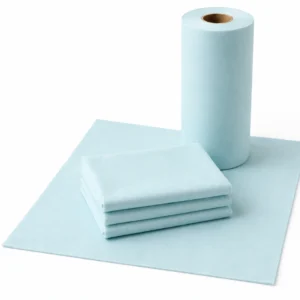
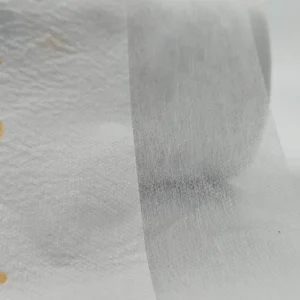
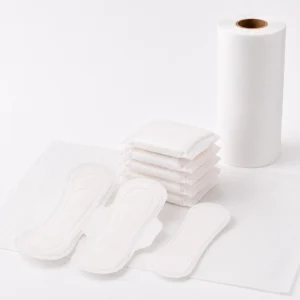
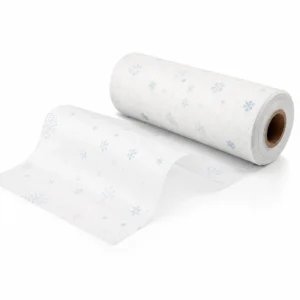
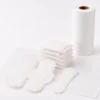
HygieSoft™ Pants & Diaper Backsheet – Breathable Softness for Premium Hygiene Care
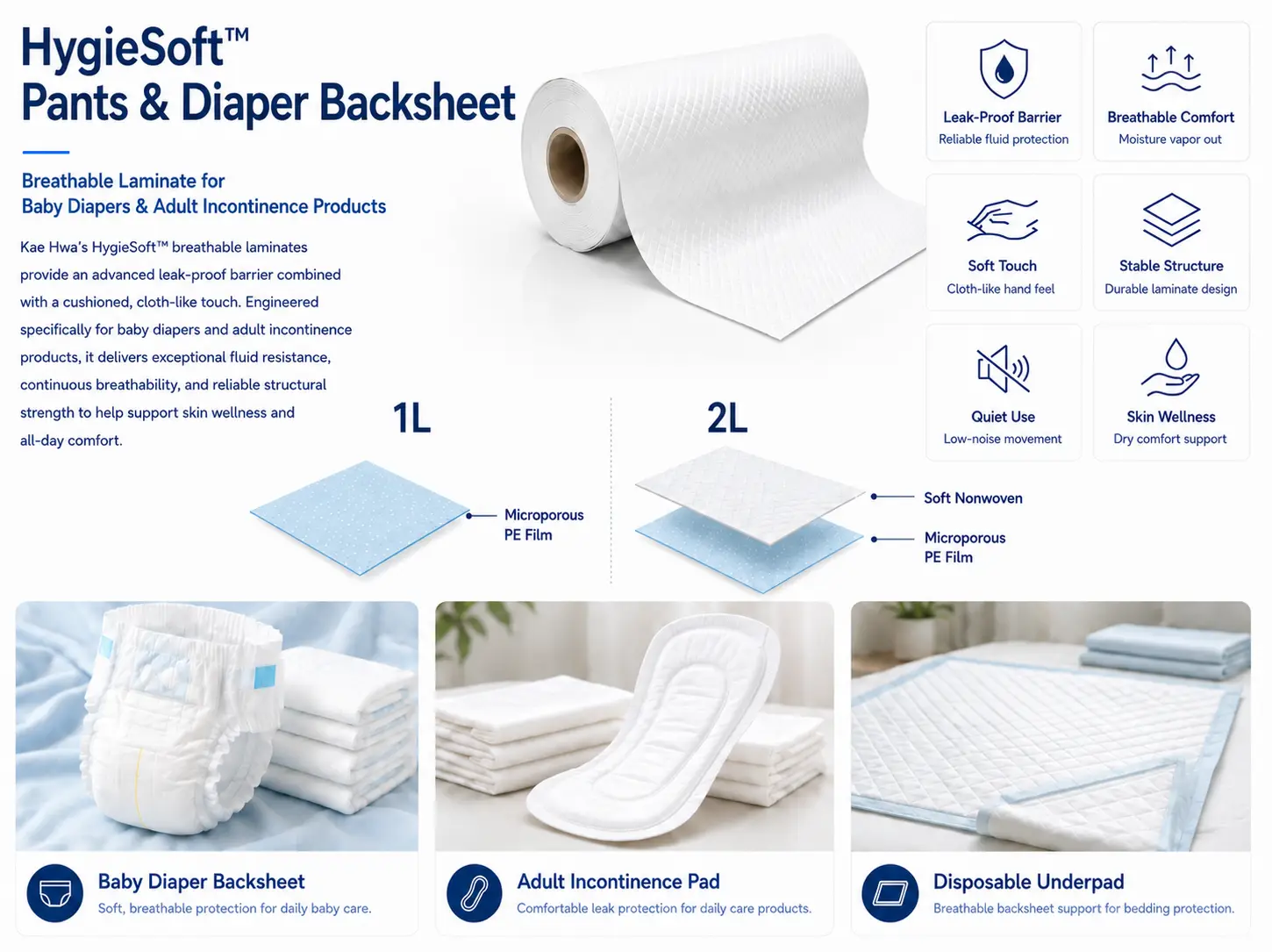
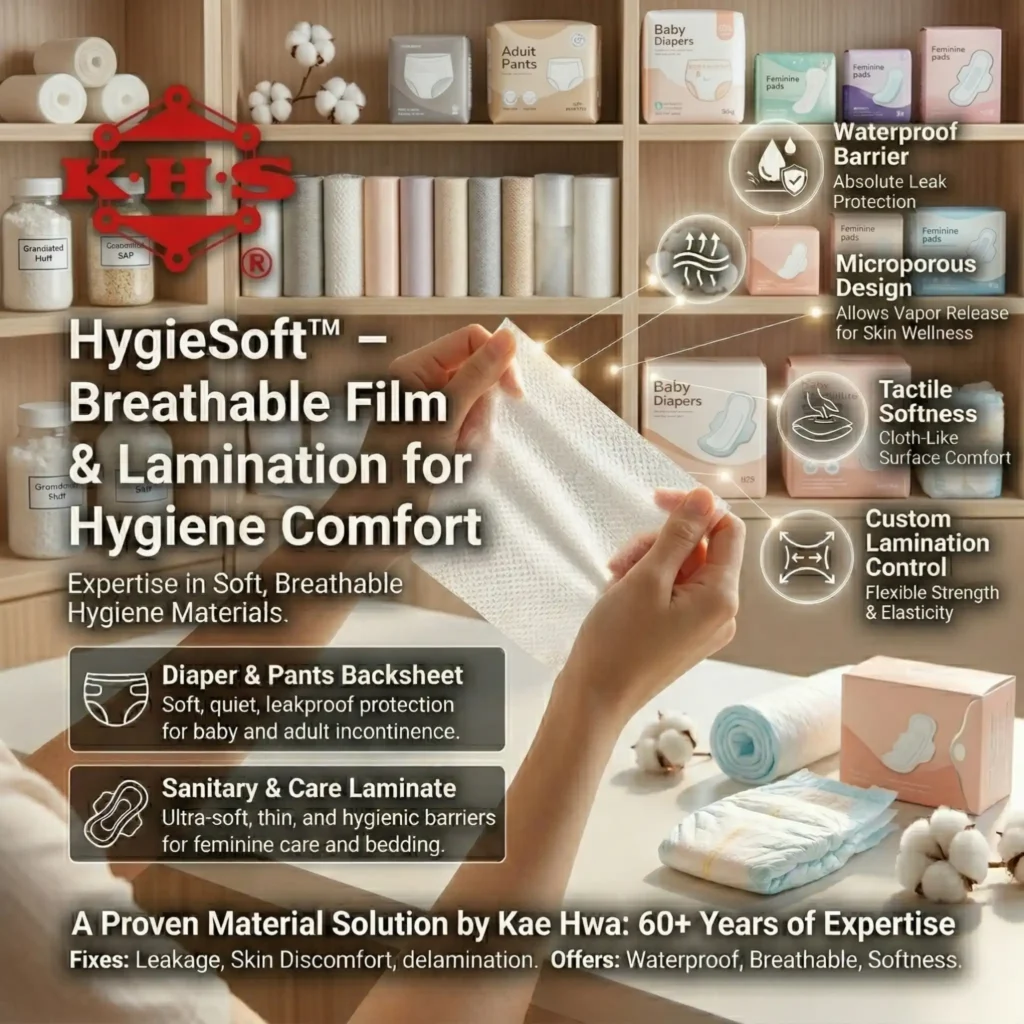
Kae Hwa’s HygieSoft™ breathable laminates provide an advanced leak-proof barrier combined with a cushioned, cloth-like touch. Engineered specifically for baby diapers and adult incontinence products, it delivers exceptional fluid resistance, continuous breathability, and reliable structural strength to ensure maximum skin wellness and all-day comfort.
Lightweight
Printable
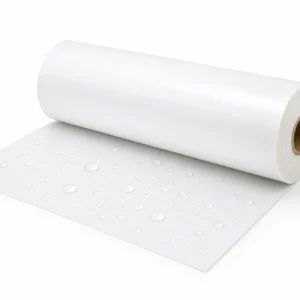
Waterproof
How Can a Highly Breathable Diaper Backsheet Improve Skin Microclimate? Four Key Material Design Considerations
For global diaper and adult incontinence care brands, leak protection is already a fundamental requirement for backsheet materials. As the market places greater emphasis on long-term wearing comfort and skin wellness, effective management of moisture and heat inside the diaper has become an increasingly important consideration in premium hygiene product design.
When a diaper remains in prolonged contact with the skin, factors such as humidity, temperature, contact with urine and feces, and friction caused by movement can all alter the internal microclimate and place additional stress on the skin barrier. In infants, this may increase the risk of diaper dermatitis. For adults who regularly use incontinence care products, microclimate management is also closely related to the prevention and management of Incontinence-Associated Dermatitis (IAD).
For this reason, a high-quality backsheet must do more than simply prevent liquid leakage. It should also provide appropriate moisture-vapor transmission, a soft hand feel, and a stable material structure to help improve the warm, humid environment inside the diaper and enhance long-term wearing comfort.
HygieSoft™, developed by Kae Hwa Industrial Co., Ltd., is a series of breathable films and laminated materials engineered for baby diapers, training pants, adult incontinence products, and other hygiene applications. Through microporous PE film technology, precision cast-film manufacturing, controlled lamination, and customized printing capabilities, HygieSoft™ helps hygiene manufacturers achieve the right balance of leak protection, breathability, softness, and converting stability for different product positioning requirements.
HygieSoft™ Core Advantages
HygieSoft™ integrates microporous PE film, soft nonwoven materials, and precision lamination technology into a backsheet structure designed for hygiene applications. For diapers, training pants, and adult incontinence products, it provides four core material advantages focused on breathability, leak protection, softness, and converting stability.
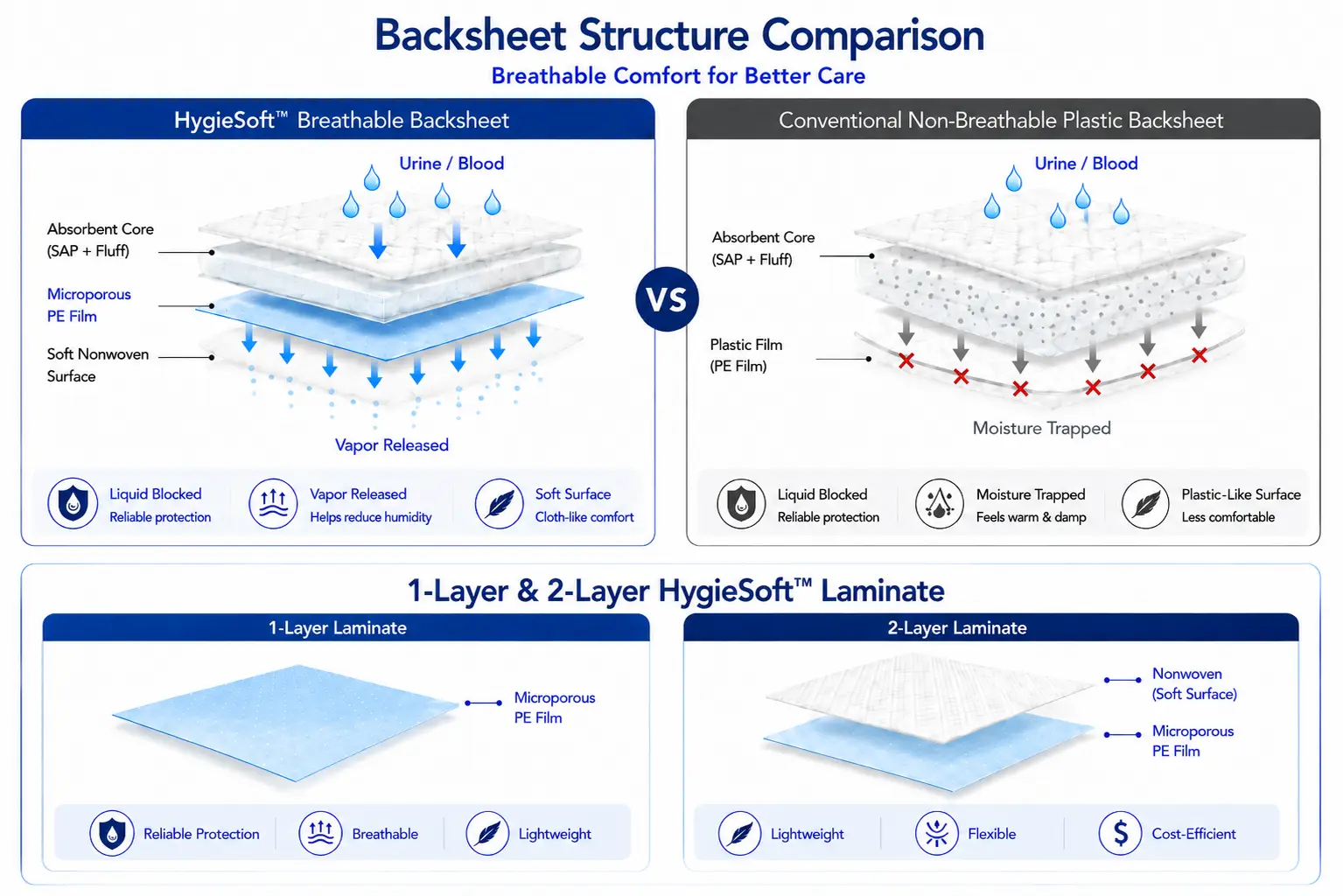
HygieSoft™ uses a microporous PE film structure that provides resistance to liquid penetration while allowing moisture vapor to pass outward. This helps the backsheet maintain an appropriate balance between leak protection and moisture-vapor transmission for diaper and incontinence applications.
With appropriately designed MVTR / WVTR performance, HygieSoft™ helps transfer accumulated moisture vapor away from the internal product environment, reducing the feeling of heat and humidity during extended wear and supporting a more comfortable microclimate and skin-wellness-oriented product design.
HygieSoft™ combines flexible microporous film with soft nonwoven materials to create a more textile-like hand feel and a quieter wearing experience. Through controlled material selection and lamination design, the composite structure can enhance softness and comfort. Kae Hwa also offers solvent-free lamination technology, helping reduce reliance on organic solvents and associated VOC emissions during manufacturing.
Through precision cast-film production and controlled lamination, HygieSoft™ is engineered to maintain film gauge uniformity, dimensional stability, and consistent composite structure. These characteristics support downstream printing, cutting, and high-speed hygiene converting, helping manufacturers establish a more stable material platform for mass production.
Key Consideration 1: Microporous Structure and Microclimate Management for Balanced Liquid Barrier and Moisture-Vapor Transmission
A diaper backsheet must prevent liquid urine from leaking outward while also reducing excessive moisture accumulation inside the product. From a material engineering perspective, this means the backsheet cannot focus on waterproofing alone. It must achieve an appropriate balance between liquid barrier performance and moisture-vapor transmission.
One of the core technologies behind HygieSoft™ is its microporous PE film, produced through precision casting and controlled stretching processes.
HygieSoft™ uses a controlled microporous structure. The combination of pore architecture and material surface properties creates resistance to liquid penetration, making it difficult for liquid urine to pass through the backsheet. At the same time, water vapor can migrate outward through the microporous structure. This enables the backsheet to balance liquid barrier performance with moisture-vapor permeability.
For baby diapers and adult incontinence products, appropriate MVTR / WVTR (Moisture / Water Vapor Transmission Rate) can help transfer accumulated moisture vapor away from the internal product environment, reducing the feeling of heat and humidity during extended wear.
In practical material design, higher moisture-vapor transmission is not always automatically better. The optimal breathable backsheet performance window should be determined according to film basis weight, pore structure, liquid barrier requirements, lamination structure, and final product design.
Key Consideration 2: Precision Lamination and Softness Control for Structural Stability and Cloth-like Touch
Modern diaper backsheets are typically more than a single plastic film. Breathable film is often laminated with a soft nonwoven layer to create an outer surface that combines leak protection with a more textile-like appearance and hand feel.
HygieSoft™ combines microporous PE film with soft nonwoven materials. By controlling lamination conditions and composite structure, the material maintains the required leak protection and breathability while preserving the softness and loft of the nonwoven layer.
Kae Hwa also offers solvent-free lamination technology, helping reduce reliance on organic solvents and associated VOC emissions during manufacturing while supporting a cleaner composite-material production process.
For hygiene applications, softness is not simply a matter of surface feel. Film flexibility, nonwoven selection, bonding strength, and overall composite design all influence the final backsheet's drape, noise level, cloth-like feel, and converting performance.
An appropriate combination of film and nonwoven materials can therefore help enhance backsheet softness and wearing comfort while maintaining the structural integrity required for diaper applications.
Key Consideration 3: Film Uniformity and Lamination Stability for High-Speed Hygiene Converting
For diaper brands, end users experience the finished product. For diaper manufacturers and converters, however, whether the backsheet can run consistently on a high-speed production line is an equally important material evaluation criterion.
In high-speed diaper manufacturing, backsheet materials require not only sufficient mechanical strength but also consistent film thickness, surface quality, and lamination uniformity. Variations in film thickness or bonding strength may affect downstream web tension control, printing, cutting, and overall converting stability.
Through precision cast-film production and controlled lamination, HygieSoft™ combines softness, dimensional stability, and the structural strength required for converting within a lightweight material construction. This helps hygiene manufacturers establish a more stable backsheet material platform for large-scale production.
Consistency becomes especially important in high-volume manufacturing. Rather than evaluating only the performance of a single sample, purchasing and engineering teams should consider whether material performance remains consistent across different production lots, across the width and length of each roll, and during extended converting runs.
For this reason, film gauge uniformity, lamination stability, and roll quality should be evaluated together with breathability and leak protection when selecting a breathable backsheet material.
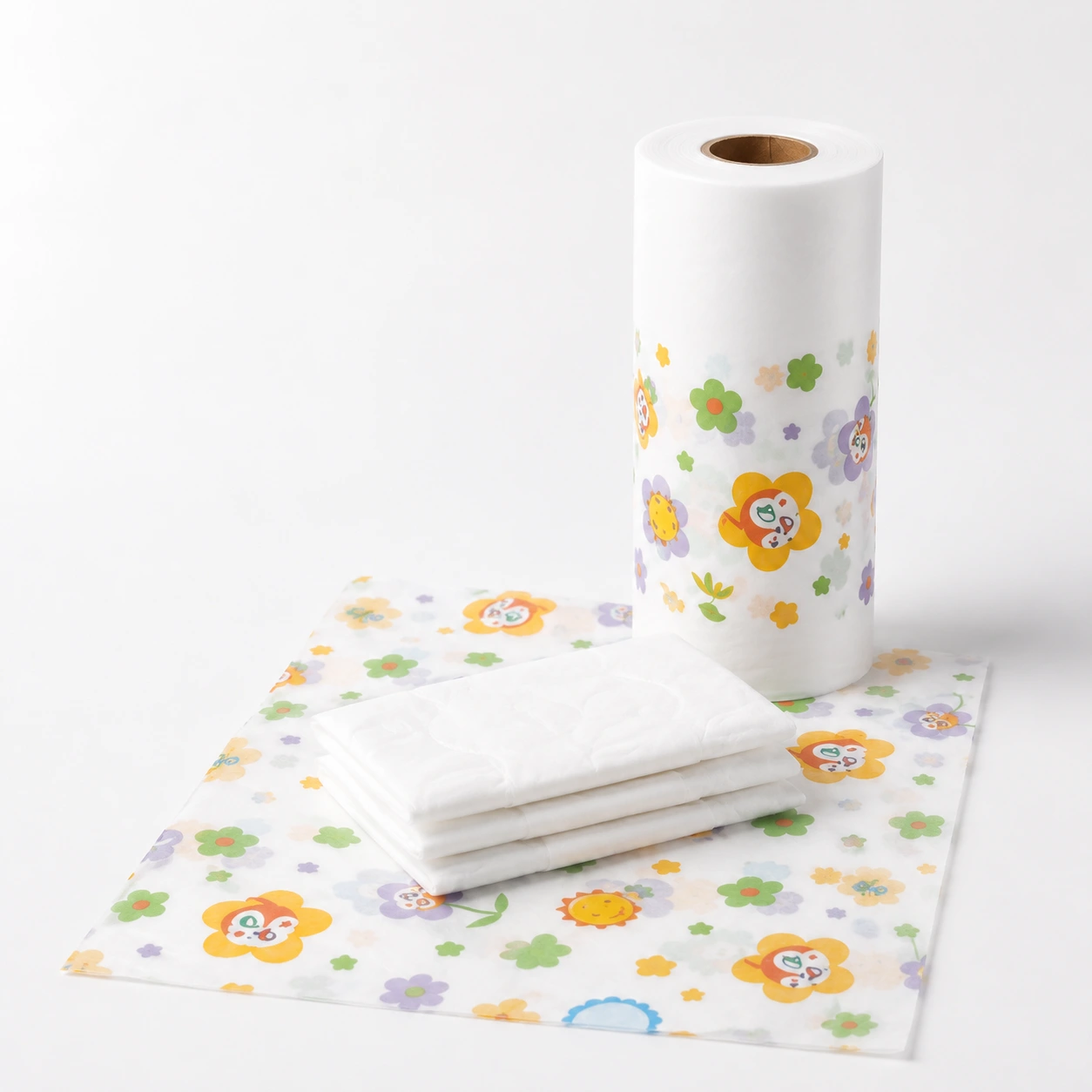
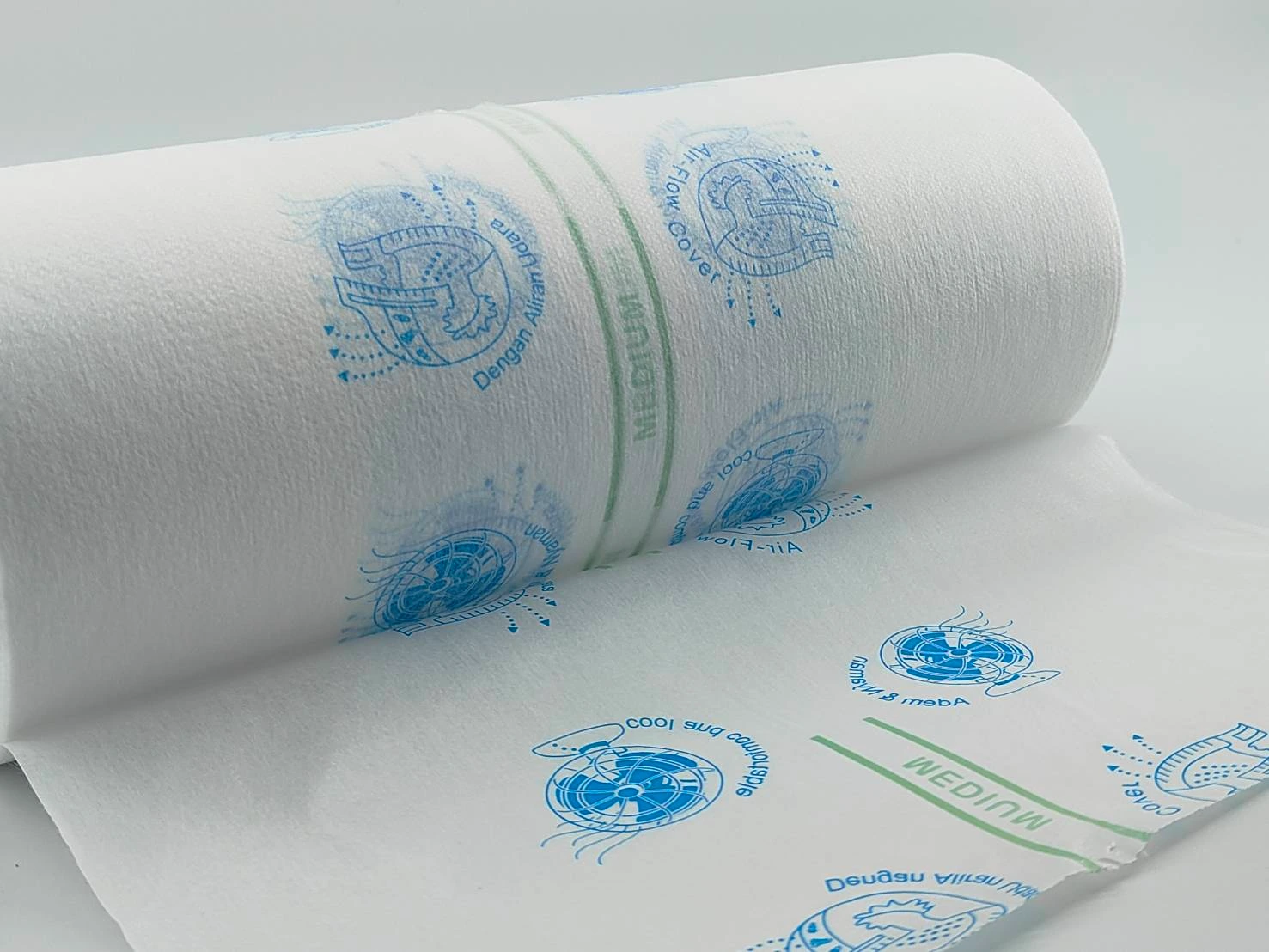
Key Consideration 4: Custom 4-Color Printing That Turns the Backsheet into Part of the Brand Identity
The backsheet of a diaper or personal hygiene product is also one of the most visible product surfaces for consumers.
Beyond functional performance, patterns, colors, brand graphics, and product-line identification can all be incorporated through backsheet printing to create stronger product differentiation.
Kae Hwa Industrial provides customized 4-color printing capabilities for functional hygiene films, enabling brands to integrate graphics, color systems, and visual identity elements according to different product requirements.
Balancing Printing and Breathability: Through control of ink systems, print coverage, and process conditions, customized graphics and brand colors can be applied while maintaining the intended breathable and liquid-barrier performance of the material. Final performance can be validated according to the specific print design, coverage ratio, and product specification.
For major hygiene brands and OEM manufacturers, this means the backsheet is no longer simply a hidden functional component within the product structure. It can become an active part of product design and brand identity.
How to Select the Right Breathable Backsheet Material for Diapers
For manufacturers of baby diapers, training pants, and adult incontinence products, selecting a breathable backsheet should involve more than comparing a single “breathability” value.
A backsheet material suitable for mass production must be evaluated based on both end-use requirements and converting conditions.
MVTR or WVTR evaluates a material's ability to transmit moisture vapor and is one of the key performance indicators for breathable backsheets.
However, results must always be compared together with the relevant test method and test conditions. Values obtained under different standards or environmental conditions are not necessarily directly comparable.
When selecting a material, manufacturers should define an appropriate moisture-vapor transmission range according to the structural requirements of baby diapers, adult incontinence products, or other hygiene applications.
High breathability should not come at the expense of leak protection.
The backsheet still requires sufficient liquid barrier performance to reduce the likelihood of urine penetrating the material under pressure or during prolonged contact. Hydrostatic resistance, or hydrohead, should therefore be evaluated together with MVTR / WVTR rather than considered as a separate performance parameter.
Basis weight directly affects material weight, hand feel, mechanical performance, and cost.
Lighter structures can support softer and more lightweight product designs, but the material must still maintain adequate stability during downstream lamination, printing, and high-speed converting.
The optimal basis weight is therefore not simply the lowest possible value. It should be selected according to product positioning and converting requirements.
Baby diapers, training pants, and adult incontinence products are designed for extended contact with the body. As a result, backsheet softness, surface feel, and overall drape can significantly influence the perceived comfort and quality of the finished product.
In addition to the film itself, the type and basis weight of the laminated nonwoven, as well as the bonding structure, can influence the final cloth-like touch.
For high-speed production, consistent bonding between the film and nonwoven is essential.
A stable composite structure can help reduce process variation during tension control, cutting, printing, and final product assembly. Lamination quality and structural stability should therefore be included in pre-production and mass-production validation.
If the product requires graphics, size identification, logos, or different visual systems for multiple product lines, print compatibility should be confirmed early in the development process.
Manufacturers should also evaluate whether printing coverage could affect the required moisture-vapor transmission or liquid-barrier performance.
Printing should not be treated as a decorative step added only at the end of development. It should be developed and validated together with the overall backsheet material design.
Different diaper production lines, product dimensions, and converting equipment may require different roll widths, basis weights, film structures, and nonwoven combinations.
For B2B hygiene manufacturers, supplier capability should therefore be evaluated not only by standard performance data, but also by the ability to customize film structures, lamination configurations, roll widths, and printing according to project requirements.
From Breathable Film to a Complete Backsheet Solution
Designing a high-quality diaper backsheet is not simply a choice between leak protection and breathability.
A mature backsheet system must consider microclimate management, liquid barrier performance, softness, film gauge uniformity, lamination stability, print design, and high-speed converting requirements as an integrated material system.
Through microporous PE film technology, precision cast-film manufacturing, soft-touch lamination, and customized printing capabilities, HygieSoft™ provides baby diaper, training pants, adult incontinence, and other hygiene product manufacturers with breathable backsheet material solutions that can be adapted to specific end-product requirements.
From film performance to actual converting conditions, the optimal backsheet design ultimately depends on the requirements of the finished product. Early material specification alignment and structural validation can help brands and manufacturers develop hygiene backsheet solutions that balance leak protection, breathability, comfort, and mass-production stability.
Key Applications
HygieSoft™ soft breathable backsheet materials combine microporous PE film with soft nonwoven laminates to achieve a balanced combination of breathability, liquid barrier performance, soft hand feel, and converting stability. Material structures can be customized according to the performance and processing requirements of different hygiene products.
Suitable for diaper backsheets that require softness, breathability, and reliable leak protection, helping support a more comfortable microclimate during extended wear.
Designed for adult diapers and incontinence care products where breathability, liquid barrier performance, and a cloth-like touch can enhance long-term wearing comfort and overall product quality.
Suitable for training pant backsheets that require softness, lightweight construction, and stable converting performance for active use and high-speed hygiene production.
Suitable for absorbent hygiene products used in medical, long-term care, and home-care environments, combining liquid barrier performance, breathable comfort, and stable laminated construction.
Specification
Brand
HygieSoft™
Product Form
Roll
Material
Breathable PE Film + Soft Nonwoven
Structure
2-Layer or 3-Layer Microporous Composite
Breathability Mechanism
High Vapor Permeability
Barrier Properties
High Hydrostatic Pressure Resistance
Surface Treatment
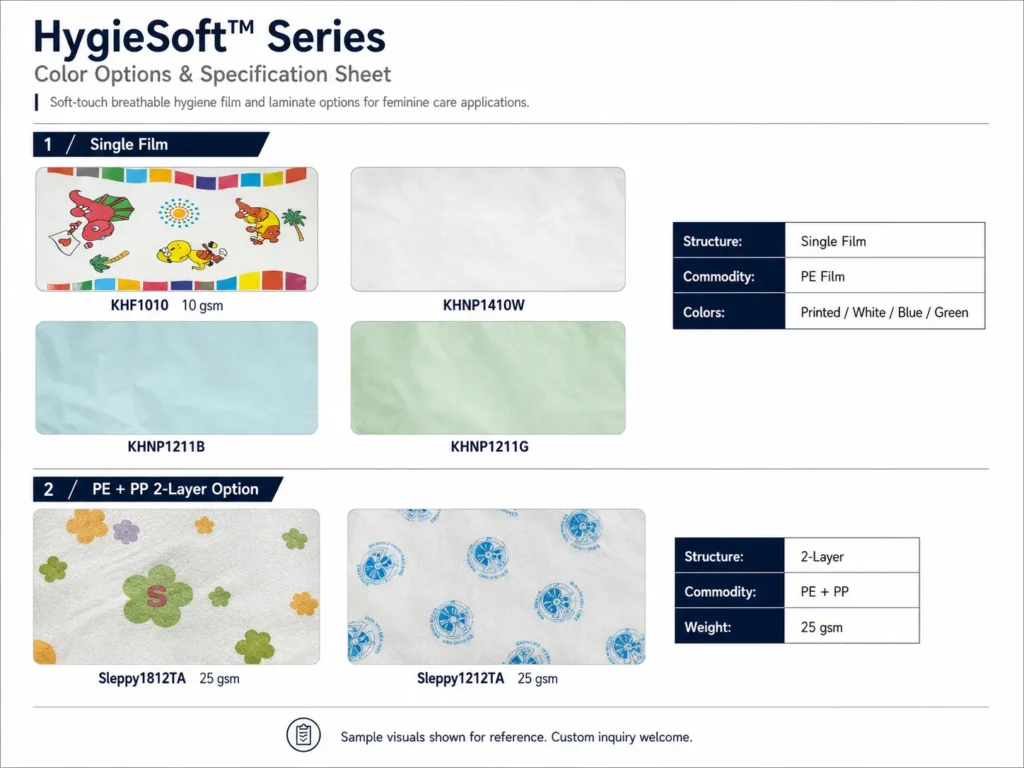
Smooth / Micro-Embossed / Custom 4-Color Printing
Weight
22 - 45 gsm
Overall Width
80 - 2000 mm (Customizable)
Length
800 - 1500m
Application
Baby diapers, adult incontinence pants, training pants
Redefining the Boundaries of Breathable Technology
Understanding Skin Wellness — The Benchmark for Premium Diapers
In the disposable hygiene industry, preventing leaks is only the baseline; maintaining skin wellness is the true benchmark of a premium product.
When urine is absorbed by the core, the trapped moisture creates a humid environment. To meet top-tier skincare requirements, the backsheet must act as a breathable valve. HygieSoft™ achieves this by allowing microscopic water vapor to escape while locking in macroscopic liquids, directly reducing the incidence of diaper dermatitis (diaper rash).
Why Kae Hwa Is Trusted in Hygiene and Care Materials
With over 60 years of polymer and lamination expertise, Kae Hwa is a proven specialist in breathable films used in the global hygiene and personal care industry. Our materials are manufactured under strict ISO 9001 and ISO 14001 quality systems, ensuring reliable, safe, and consistent performance.
We develop hygiene laminates using proprietary technologies such as precision microporous casting and eco-friendly solvent-free lamination, enabling global diaper brands to deliver products that offer uncompromising protection and ultimate softness.
Diaper rash is primarily caused by trapped heat and moisture. HygieSoft™ features billions of microscopic pores that allow hot air and water vapor to escape from the diaper (High MVTR), keeping the skin dry and cool, while its waterproof integrity blocks all liquid urine from leaking.
Yes. We use advanced solvent-free lamination technology. Unlike traditional adhesives that may contain residual chemicals or VOCs (Volatile Organic Compounds), our process is eco-friendly and results in an odorless, hypoallergenic fabric that is safe for direct contact with delicate skin.
Absolutely. We offer high-resolution 4-color printing technology directly on the breathable film. We can customize the patterns, colors, and logos to match your brand identity while ensuring the printing process does not affect the material’s breathability or waterproof performance.
Standard plastic (non-breathable PE) feels like a plastic bag, makes noise, and traps moisture. HygieSoft™ is a textile-like laminate; it is whisper-quiet, incredibly soft to the touch, and "breathes" like a fabric, providing a premium experience for both infants and elderly users.