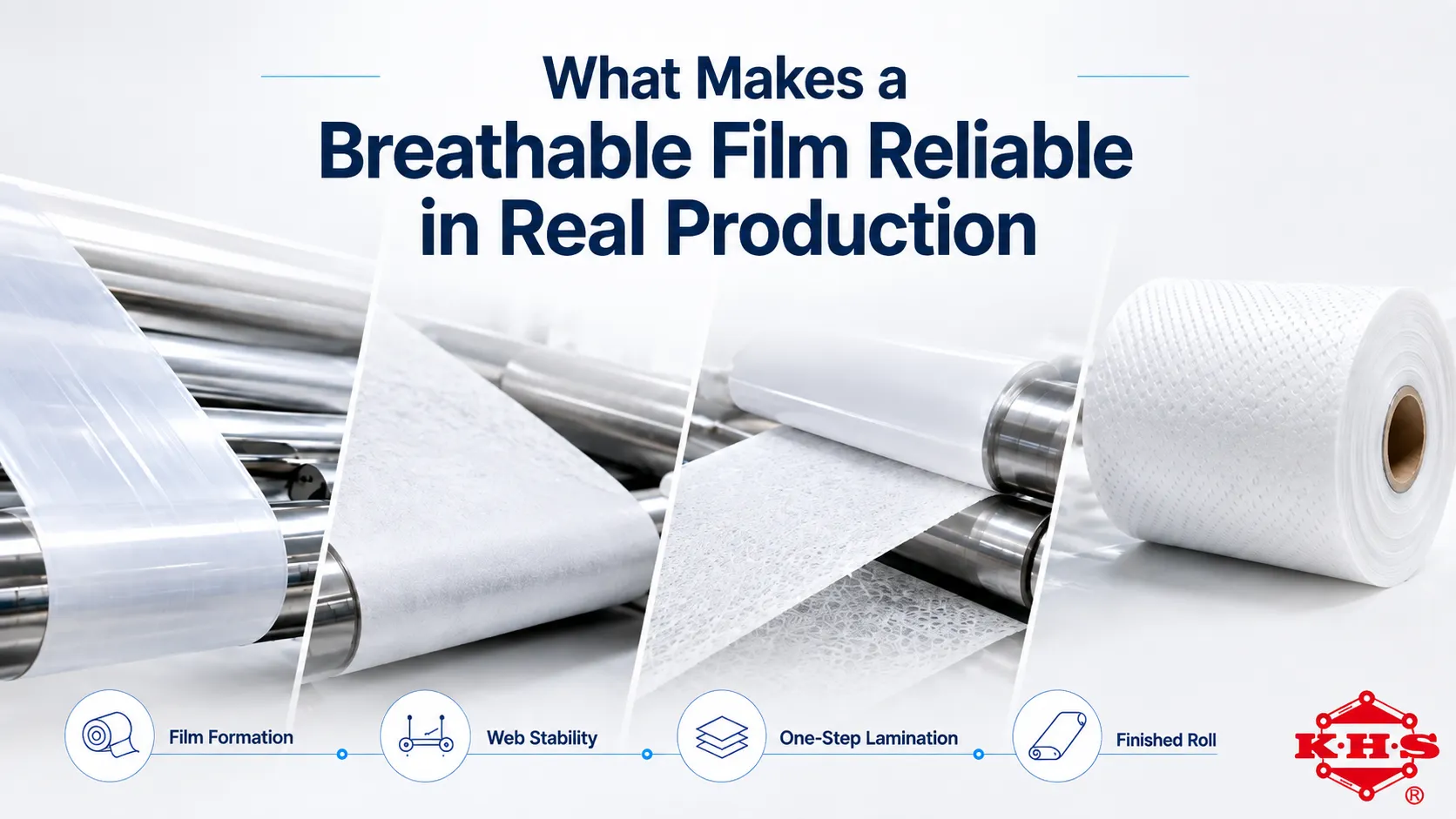
Breathable film production reliability is decided on the converting line, not only in a lab report. A breathable film can perform well in laboratory testing and still behave differently once it enters continuous production. Tension, heat, winding, lamination, and other converting conditions all influence the final result, which is why production reliability needs to be considered across the entire manufacturing process rather than from the film specification alone.
For material buyers who are new to breathable films, this difference is easy to overlook.
A technical data sheet may show the expected basis weight, thickness, WVTR, hydrostatic resistance, and tensile properties. Those numbers are important, but they do not show everything that happens when hundreds or thousands of meters of film begin moving through a production line.
This is where material specification turns into manufacturing performance.
If the TDS meets the specification, why can production still fail?
A Technical Data Sheet tells us how a material performed under defined test conditions.
A production line asks a different question.
Can the same material remain stable while it is continuously unwound, tensioned, guided, heated, laminated, rewound, printed, sealed, or cut?
A film can meet its target specification at the test point while still showing variation over a longer production run.
This does not necessarily mean the original test result was inaccurate. It means that laboratory performance and production stability describe two different aspects of breathable film production reliability.
Consider basis weight as a simple example.
Two rolls may both meet the same nominal GSM requirement. If one roll is relatively uniform while the other contains more variation across the width or along the machine direction, their behavior during continuous processing can be different.
The same principle applies to thickness, surface condition, dimensional stability, and mechanical response.
For this reason, breathable film qualification should not stop at asking whether a specification has been achieved.
It should also ask whether that performance can be maintained consistently throughout the roll and through the intended production process.
Why does film uniformity become more important once the line starts moving?
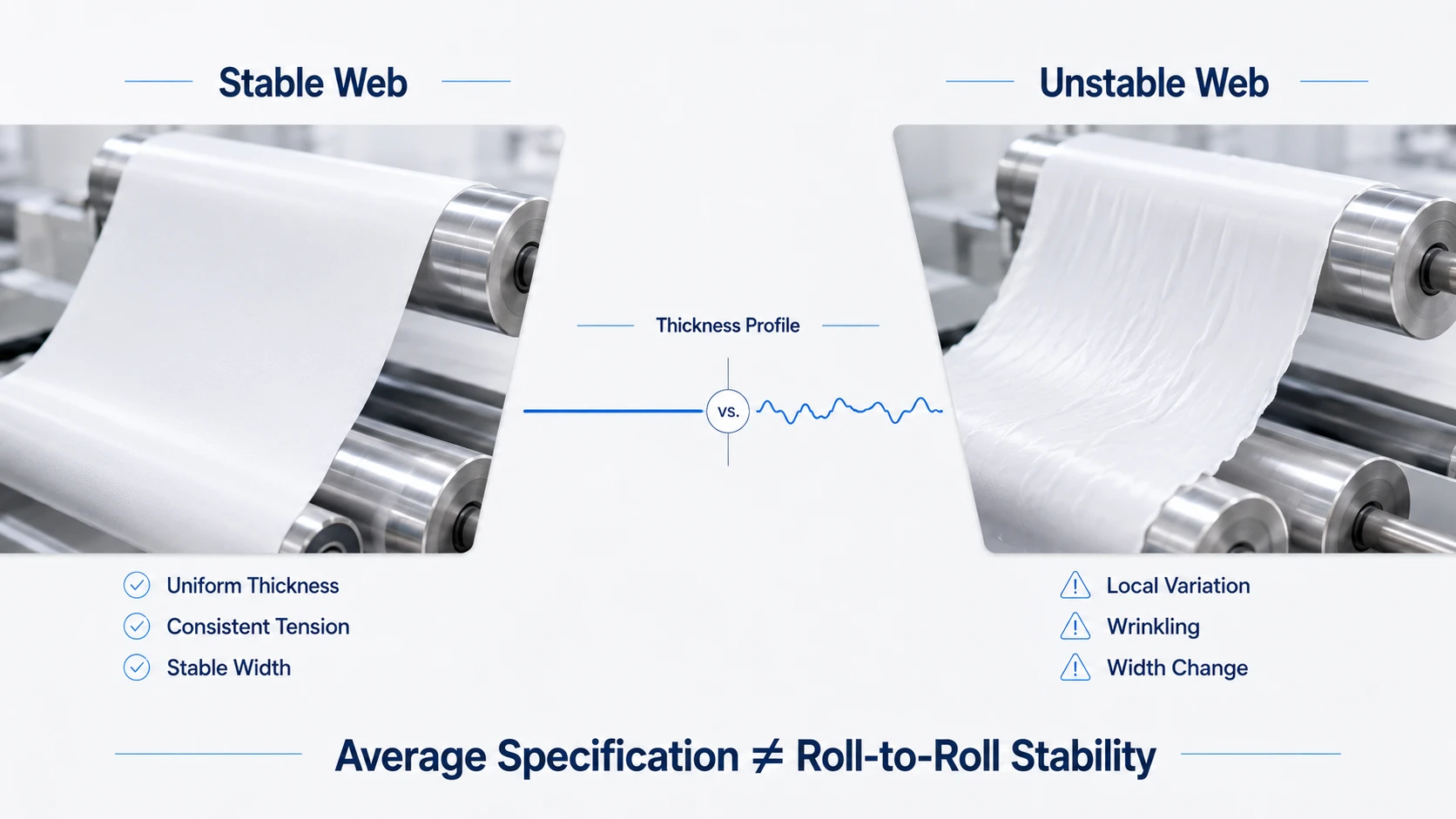
Small variations become more noticeable when a material is processed continuously.
A locally thinner area may react differently to tension. A thicker section may behave differently during winding or bonding. Repeating variation across a long production run can affect how smoothly the material travels through the machine.
For breathable films, thickness also has a relationship with functional performance.
In a microporous film, material formulation, film formation, and stretching contribute to the final pore structure. In a monolithic moisture-vapor permeable film, thickness influences the path through which moisture moves through the polymer.
This is why thickness should not be viewed only as a dimensional specification.
On Kae Hwa’s production lines, thickness is controlled to within ±0.01 mm, which keeps this variation inside a workable range for downstream converting.
It is connected to mechanical behavior, moisture transmission, barrier performance, and downstream processing.
From a production point of view, the objective is not simply to achieve the correct average thickness.
The objective is to reduce unnecessary variation before that variation reaches the converting line.
That becomes increasingly important in applications such as hygiene products, medical materials, industrial protective fabrics, functional packaging, construction membranes, and performance textiles, where the film may later be laminated or processed at commercial speed.
Why does the same film behave differently when production speed increases?
A film that appears easy to handle during a short trial may become more difficult to control as the production speed rises.
Once a film is moving continuously through rollers, the material becomes part of a dynamic web-handling system.
Web tension changes.
Acceleration and deceleration matter.
Roller alignment becomes more sensitive.
Winding behavior becomes more important.
Temperature exposure can also change because the material has less time to stabilize at each stage.
If the film stretches unevenly under tension, the web may narrow or move away from its intended position. Wrinkles can form. Tracking can become less stable. Alignment with another substrate during lamination may become more difficult.
Different polymers also react differently.
A PE breathable film selected for softness and flexibility will not necessarily respond to tension and temperature in the same way as a PP structure or a TPEE monolithic film.
This is why line speed should not be treated as an isolated machine setting.
The usable production window depends on the relationship between the film structure and the converting conditions.
When developing or selecting a film for continuous production, useful information includes the working width, expected line speed, tension conditions, temperature exposure, substrate type, bonding method, and later processing steps.
The more accurately these conditions are understood, the easier it becomes to select a material that fits the real production environment.
Why does reducing intermediate processing matter?
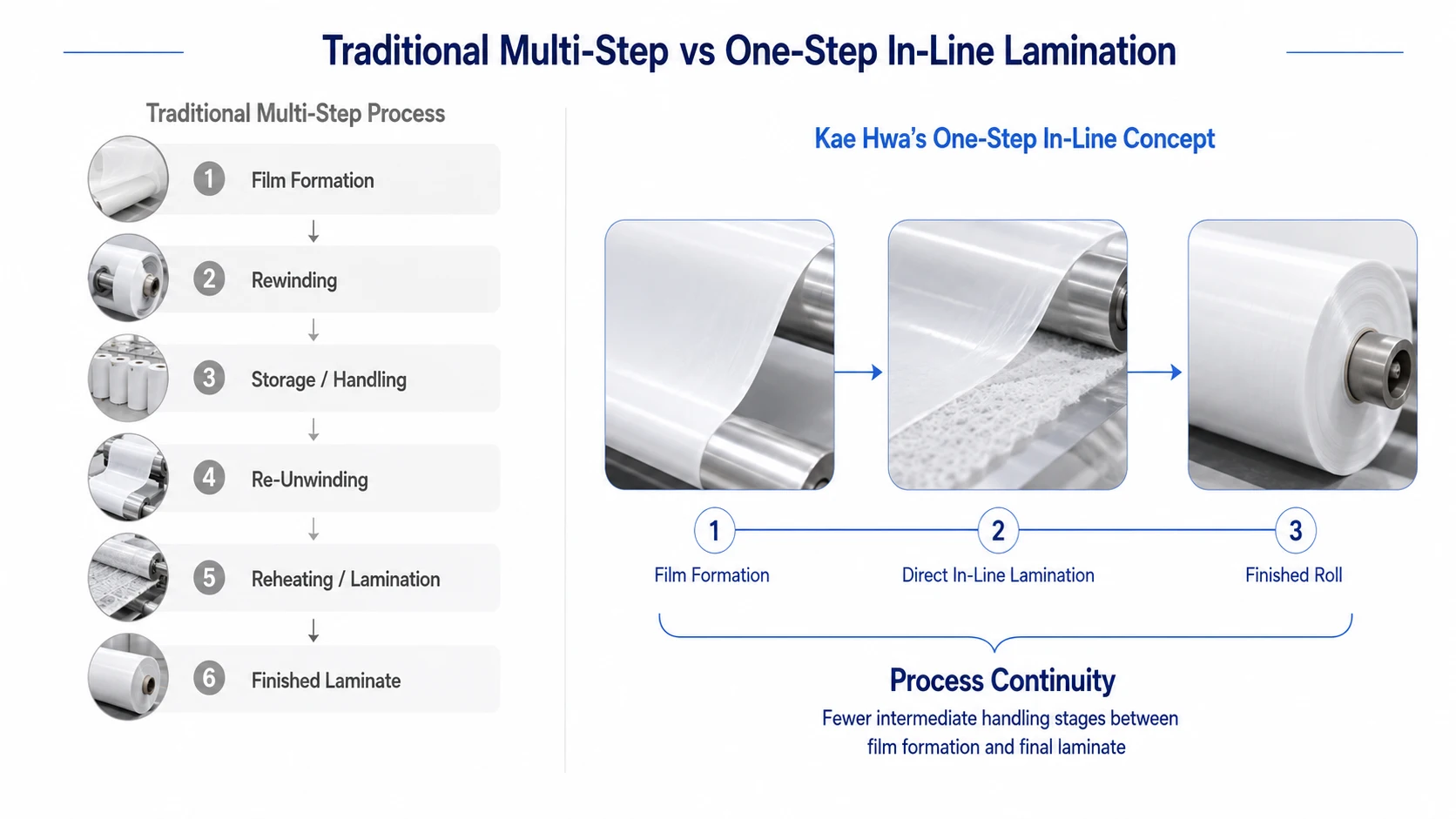
Film production and lamination are often treated as separate manufacturing stages.
A membrane may first be produced and wound into a roll. It can then be stored, transported, or moved to another production line before being unwound again for lamination.
There is nothing inherently wrong with this production route.
However, every additional stage introduces another set of process conditions that needs to be controlled.
The film experiences winding tension during the first roll formation.
It later experiences another unwinding cycle.
The web must be stabilized again before bonding.
Storage and handling take place between the two processes.
The lamination line then introduces its own heat, pressure, substrate tension, bonding pattern, and winding conditions.
Each stage creates another opportunity for manufacturing variation.
This is one reason Kae Hwa uses one-step in-line lamination for applicable laminated material structures.
Instead of treating film formation and lamination as completely separate operations, the membrane can move from film formation directly into bonding with the selected nonwoven or textile substrate within a continuous production process.
The film does not need to be manufactured as a separate finished roll before entering an independent lamination stage.
The practical value is not simply faster manufacturing.
It is process continuity.
Film formation, web behavior, substrate feeding, bonding conditions, and final roll formation can be considered as connected parts of the same manufacturing process.
Reducing intermediate rewinding and reheating also means fewer disconnected handling stages between membrane formation and the finished laminate.
For breathable materials, this relationship matters because the membrane will no longer function as an independent film after lamination.
Its final performance will depend on what happens during bonding as well.
One-step in-line lamination therefore provides a manufacturing environment in which film and laminate development can be considered together rather than as two unrelated processes.
It does not remove the need for final testing.
What it does is create a more direct and controllable manufacturing path from membrane formation to finished composite material.
Why can lamination change the performance of a breathable film?
Once a membrane is laminated, it becomes part of a new material system.
A nonwoven, woven textile, knitted fabric, adhesive, bonding pattern, or other substrate can change the way the final material behaves.
Heat and pressure introduced during bonding also become part of the equation.
For microporous membranes, excessive thermal or mechanical stress may influence the structure responsible for breathability.
Adhesive distribution can affect the effective area available for moisture-vapor transmission.
Bonding conditions can influence flexibility and dimensional stability.
The substrate adds another set of properties.
A nonwoven may improve handling strength and provide a softer surface.
A woven fabric may contribute abrasion resistance and mechanical durability.
A backing layer may protect the membrane in a multilayer textile structure.
This means that the original film specification cannot automatically be used as the specification of the finished laminate.
A film with a particular WVTR does not guarantee that the final laminated structure will show exactly the same result.
The more useful engineering question is whether the finished material still performs within the required range for its intended application.
Where relevant, the laminate should therefore be evaluated for properties such as moisture-vapor transmission, waterproofness, bonding strength, mechanical performance, dimensional stability, and processing compatibility.
For applications with specific regulatory or performance requirements, additional testing may also be necessary.
The material should ultimately be qualified in the form in which the customer will actually use it.
If a sample works well, does that mean the material is ready for mass production?
A successful sample is a good starting point.
It is not the same as proving breathable film production reliability at continuous commercial scale.
A small trial normally represents a limited combination of material lot, machine condition, line speed, operator setting, and production time.
Mass production introduces more variation.
Runs become longer.
Raw-material batches change.
Production equipment operates for extended periods.
Rolls are stored and transported.
The finished material may later go through printing, cutting, sealing, welding, garment conversion, or other processes.
A useful production trial should therefore look beyond whether the film simply passes through the machine.
It should evaluate whether the process remains stable:
- Does the web maintain its width?
- Does winding remain consistent?
- Are wrinkles appearing as the run continues?
- Does the bonding pattern remain uniform?
- Does the laminate retain the required performance after processing?
- Are different areas of the roll behaving consistently?
The exact questions depend on the application.
A hygiene backsheet running on an automated converting line has different priorities from an industrial protective laminate.
A breathable desiccant package has different processing requirements from a waterproof outdoor textile.
A construction membrane may need yet another combination of durability, dimensional stability, vapor transmission, and outdoor resistance.
This is why the intended application should be part of the material discussion from the beginning.
Does higher breathability mean better production performance?
Not necessarily.
Breathability is one part of the material system.
A higher WVTR (ASTM E96) may be desirable when moisture-vapor removal is a major priority, but the highest possible value is not automatically the best choice for every application.
A hygiene backsheet may need to balance vapor transmission with softness, liquid resistance, lightweight construction, and high-speed processing.
An industrial protective fabric may require a different balance between barrier performance, mechanical strength, laminate integrity, and wearer comfort.
A packaging material may need controlled vapor or air transmission while preventing powder leakage and maintaining reliable sealing.
An outdoor laminate may need waterproof pressure, moisture management, flexibility, durability, and compatibility with garment assembly.
Optimizing one specification without considering the others can move the material away from the actual production requirement.
This is also why comparing supplier data sheets only by WVTR can be misleading.
Test method, film thickness, polymer structure, processing conditions, and final laminate construction all affect how the number should be interpreted.
The goal is not to maximize every measurable property.
The goal is to establish the right performance window for the intended product and manufacturing process.
What should a buyer confirm before approving a film for mass production?
For buyers who are working with breathable films for the first time, it helps to move beyond one question.
Instead of asking only whether the film meets the specification, ask whether the material and the production process have been considered together.
Start with the intended application.
Identify the required polymer structure and functional properties.
Confirm the roll width, thickness, basis weight, surface treatment, and other physical requirements.
Then move into processing:
- How fast will the material run?
- What tension will it experience?
- Will it be laminated?
- What substrate will be used?
- Will the process involve heat, adhesive, pressure, printing, sealing, ultrasonic welding, or additional converting?
If the commercial product will be a laminate, the finished laminate should be part of the evaluation wherever possible.
Finally, separate material specifications from final-product requirements.
A membrane may meet its own technical specification while the finished garment, package, hygiene product, or construction material requires additional validation.
Those are different stages of qualification.
A reliable development process therefore connects four things.
Material design
Film production
Converting and lamination
Final material validation
For Kae Hwa, one-step in-line lamination provides a practical connection between the middle two stages.
The membrane is not treated only as a roll that leaves the film line.
Its behavior during bonding and its role in the final composite can also be considered during material development.
That is where breathable film production reliability begins to move beyond the TDS and into the actual manufacturing process.
Discuss Your Production Conditions With Kae Hwa
Every converting line places different mechanical and thermal demands on a breathable membrane, which is exactly where breathable film production reliability is decided in practice.
If you are evaluating a breathable film or laminate for hygiene, medical, industrial protection, functional packaging, construction, agriculture, or performance textile applications, Kae Hwa can review the required film structure together with your intended converting conditions.
Share your target material, working width, film or laminate structure, required performance, and downstream process with our team to begin a technical discussion or sample evaluation.