
Rethinking Waterproofing: The Thermodynamic Power of Microporous Membranes
For generations, the concept of “protection” in material engineering was strictly binary: a surface was either fully exposed to the environment or completely sealed off. From the use of primitive animal hides to the mass production of polyethylene plastics in the 20th century, the ultimate objective was absolute isolation. However, this total-sealing philosophy has exposed a major vulnerability in modern applications. Whether we are discussing the building envelope of a high-rise, the sensitive root system of an agricultural crop, or the micro-climate inside a desiccant package, trapping moisture is frequently more detrimental than letting water penetrate.
This comprehensive guide examines the industry-wide paradigm shift toward Microporous Breathable Membranes. We will break down the fundamental physics of Moisture Vapor Transmission Rates (MVTR), the specialized chemistry behind mineral compounding, and the cutting-edge In-Line Lamination technologies that make this engineering paradox a reality. By dissecting the concept of the “Invisible Pore,” we demonstrate how precision engineering resolves universal moisture management challenges across the construction, agriculture, packaging, and medical sectors.
1. The Trap of Absolute Waterproofing: When Sealing Causes Destruction
In our collective mindset, a waterproof barrier is an impenetrable wall—much like a traditional raincoat, a plastic sheet, or a rubber boot. While these “monolithic” barriers do an excellent job of repelling rain, they introduce a secondary hazard that remains unseen until the damage is already done: they trap water vapor.
According to the laws of thermodynamics, moisture naturally travels from areas of high concentration (warm and humid) to areas of low concentration (cool and dry). When we encase a structure, a farming field, or the human body in a non-breathable plastic sheet, we disrupt this natural balance. Vapor generated from within—be it from indoor activities, soil evaporation, or human sweat—inevitably collides with the impermeable layer and condenses.
This trapped moisture initiates a destructive cycle:
-
In Construction: It causes interstitial condensation, which rots timber framing and degrades insulation efficiency.
-
In Agriculture: It fosters anaerobic soil conditions that essentially “cook” root systems and encourage the spread of pathogens.
-
In Functional Packaging: It neutralizes desiccant sachets. A wrapper that doesn’t breathe stops the active ingredients from absorbing ambient moisture, while poor-quality barriers risk leaking highly corrosive chemicals onto the protected goods.
The answer to this widespread issue requires a material intelligent enough to differentiate between water’s two primary states: liquid and gas. This is the exact domain of Microporous Film Technology—the science of engineering billions of microscopic holes into a waterproof wall.
2. The Physics Behind the “Perfect Hole”: Scale and Surface Tension
How is it possible to manufacture a barrier that stops a storm but permits a vapor molecule to pass? It isn’t magic; it is the precise application of geometric scaling and fluid dynamics.
2.1 The Mathematics of Scale
To fully grasp this engineering feat, we must consider the specific dimensions of the molecular world.
-
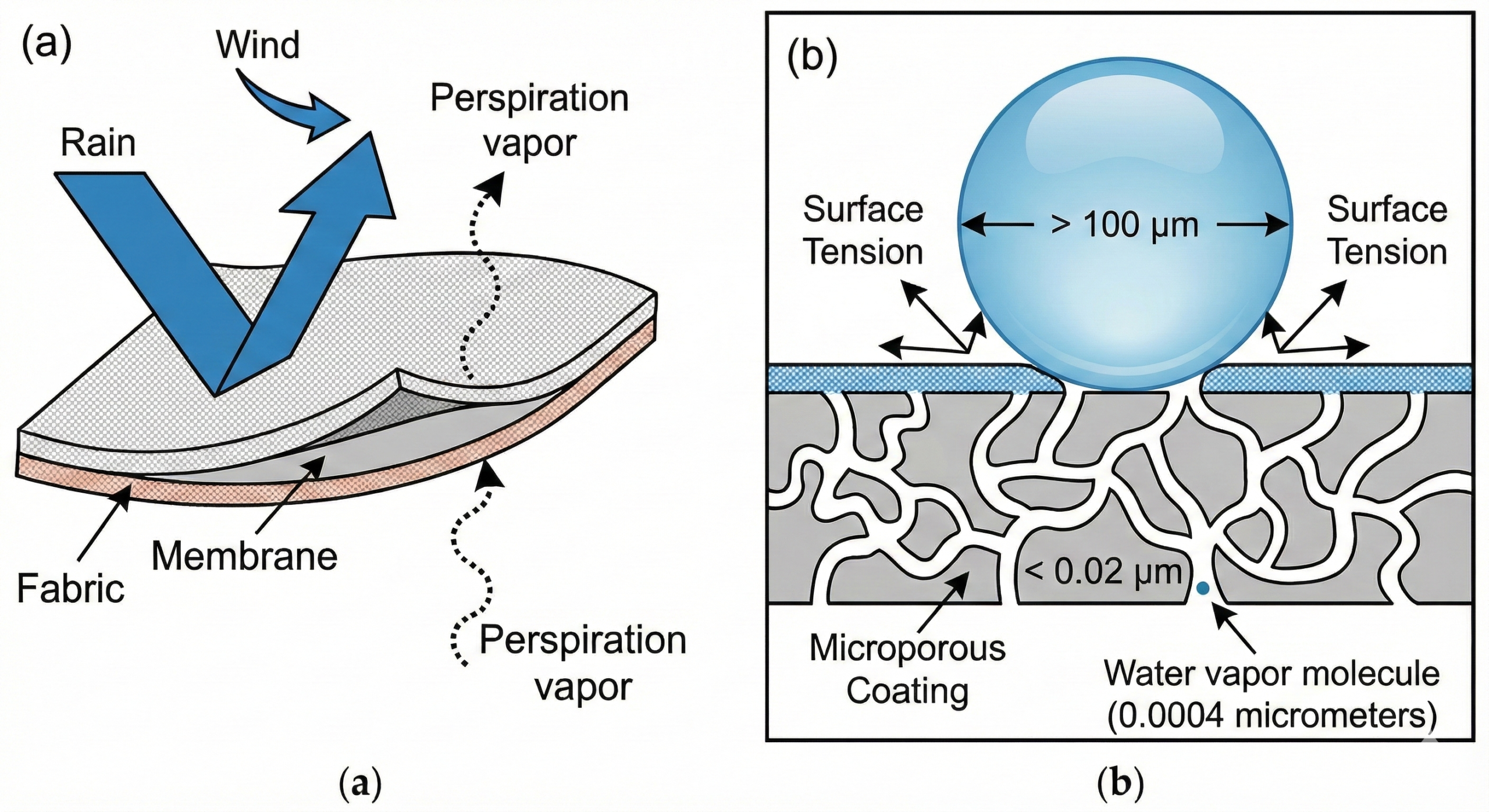
The Liquid Threat: A standard raindrop or liquid water droplet is relatively massive, typically ranging from 100 microns (µm) to 3,000 µm in diameter. Even fine mist droplets rarely fall below 50 µm.
-
The Vapor Solution: In stark contrast, a molecule of water vapor (moisture) is exceptionally tiny, measuring roughly 0.0004 µm.
-
The Microporous Filter: High-performance membranes are engineered with pore sizes ranging between 0.1 µm and 10 µm.
This dimensional disparity creates a physical sieve. Because the engineered pore is thousands of times larger than a vapor molecule, moisture easily drifts through via diffusion. However, the pore remains significantly smaller than the smallest liquid droplet. It is akin to throwing a basketball at a chain-link fence—the air flows freely, but the ball is physically stopped.
2.2 The Invisible Shield: Surface Tension
Size only accounts for half of the equation. Liquid water also possesses high surface tension—a cohesive force that makes water molecules cling tightly together, maintaining a spherical droplet shape rather than flattening out.
When a raindrop impacts a premium microporous film, this surface tension stops the droplet from deforming enough to squeeze through the tortuous microscopic pathways. Unless the external water pressure (Hydrostatic Head) surpasses the material’s critical threshold, the droplet simply bridges the pore opening without infiltrating it. This dynamic is what allows the material to achieve outstanding water column resistance while staying entirely open to vapor flow.
3. Manufacturing the Invisible: The Birth of Microporous Films
Engineering these highly specific pores demands a sophisticated production method known as Casting Film Extrusion combined with MDO (Machine Direction Orientation) stretching.
3.1 The Critical Role of Mineral Particles
The “holes” in these membranes are not mechanically punched; they are generated through stress-induced void formation.
-
Compounding: The procedure starts by blending a polyolefin resin (Polyethylene PE or Polypropylene PP) with extremely fine, specialized mineral particles, such as Calcium Carbonate.
-
Extrusion: This compound is melted and extruded onto a chilled casting roller. Precision Casting Technology is vital here to guarantee extreme thickness uniformity, maintaining tight tolerances of ±0.01 mm. Even minor thickness variations would result in inconsistent breathability.
-
MDO Stretching: The solidified film is then rapidly stretched in the machine direction. Because the polymer is elastic and the embedded minerals are rigid, the polymer pulls away from the particles.
-
Micro-Void Creation: This separation forms microscopic cavities (pores) around each mineral particle. Rather than straight tunnels, these create complex, “tortuous paths” that effectively trap liquid water but expertly guide vapor out. Learn more about how these films maintain high leakage resistance.
3.2 Why Is Lamination a Challenge for Microporous Films?
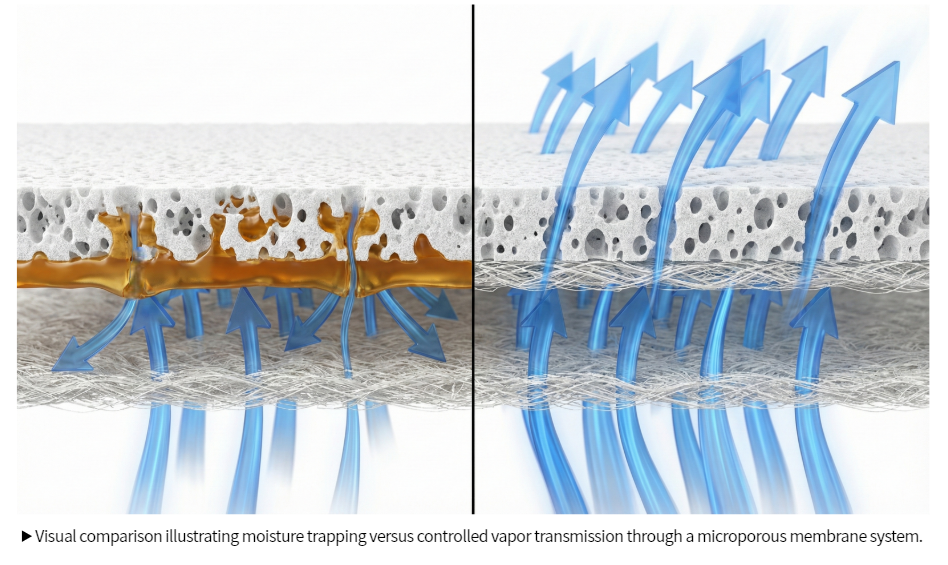
While a microporous film functions perfectly on its own, it is often too delicate to survive the harsh conditions of a construction site or an agricultural field. It must be bonded to a reinforcing nonwoven fabric.
Traditional lamination relies on adhesive glue, which introduces a major flaw: glue easily clogs the exact microscopic pores you just engineered. To solve this, the premium industry standard utilizes In-Line Lamination Technology. By bonding the microporous film to the nonwoven substrate immediately after casting—while the polymer remains semi-molten—manufacturers create a strong thermal bond without using any solvents or heavy adhesives.
-
Benefit 1: Maximum Breathability (zero glue to block pores).
-
Benefit 2: Superior Durability (integral bonding prevents delamination).
-
Benefit 3: Sustainability (a completely solvent-free manufacturing process).
4. One Science, Four Industry Solutions
The incredible versatility of microporous technology means it can eliminate critical failure points across a wide spectrum of industries. While the brand names vary, the underlying physics remains consistent.
4.1 Construction: The Breathing Building Envelope
Contemporary energy codes require airtight structures for heat retention, frequently resulting in “Sick Building Syndrome” where moisture is trapped within the walls.
-
The Threat: Moisture from everyday living migrates through drywall and condenses upon hitting cold exterior sheathing, rotting timber and fostering toxic black mold.
-
The Solution: Breathable roofing underlayments and wall wraps, such as BuildBreathe™, act as a Weather Resistive Barrier (WRB). They block wind-driven rain while maintaining a high MVTR, allowing the structure to “exhale” trapped moisture and preserving the building’s integrity according to international ISO building envelope standards.
4.2 Agriculture: Protecting the Living Soil
Soil is a dynamic, living ecosystem. Traditional “plasticulture” (using black plastic mulch) often suffocates the earth, creating an anaerobic environment that damages beneficial microbes and overheats crop roots.
-
The Threat: Lack of oxygen and heat stress lead to poor nutrient absorption and diminished harvests.
-
The Solution: Sustainable agricultural laminates like AgriGuard™ serve as a “living barrier.” They are waterproof (preventing fertilizer runoff) and light-blocking (stopping weed growth naturally), yet their breathability facilitates crucial gas exchange defined in historical agricultural studies on Plasticulture. This regulates soil temperature and promotes a thriving root zone.
4.3 Functional Packaging: Maintaining Kinetic Balance
For active packaging solutions like desiccant sachets (silica gel, clay, or calcium chloride), the performance of the wrapper dictates the efficacy of the entire product.
-
The Threat: Standard plastic wrappers block moisture entry, making the desiccant useless. Conversely, overly porous materials (like basic paper) allow saturated, liquefied chemicals to leak out, which can ruin electronics, leather, or pharmaceuticals.
-
The Solution: Microporous films like PackDry™ provide a “Controlled Transmission Rate.” They permit high volumes of vapor to enter for fast absorption, but establish a superior liquid barrier to prevent reverse leakage. They also stop fine chemical dust from escaping, making them ideal for specialized cleanroom environments following global ISO data verification.
4.4 Medical & Hygiene: The Ultimate Comfort Factor
Applications involving direct contact with human skin demand the highest level of sensitivity.
-
The Threat: In products like diapers, sanitary pads, or medical PPE, non-breathable plastic backings trap heat and cause skin maceration, leading to severe discomfort and rashes.
-
The Solution: Advanced breathable films offer a soft, “cloth-like” texture. They successfully block blood and bodily fluids while permitting body heat and sweat vapor to vent. This maintains skin dryness, preserves a healthy pH balance, and maximizes comfort during prolonged use.
5. Beyond the Pore: Sustainability and Customization
The future of waterproofing extends beyond mere performance; it requires environmental responsibility. The era of disposable, unrecyclable plastics is drawing to a close. Polyolefin-based (PE/PP) microporous membranes represent a highly sustainable alternative.
5.1 The Monomaterial Advantage
Because advanced In-Line Lamination securely bonds PE films to PE/PP nonwovens without chemical adhesives, the final composite is much easier to recycle compared to heavily glued multi-material laminates. Industry leaders prioritize solvent-free manufacturing, drastically cutting down on Volatile Organic Compounds (VOCs) and reducing overall energy consumption to align with eco-friendly frameworks like the Global Recycled Standard (GRS).
5.2 Tailored MVTR Performance
Not all “pores” should be identical. Different applications demand varying moisture transmission rates:
-
High Breathability: Essential for activewear or medical gowns where heat stress is a significant hazard.
-
Controlled Breathability: Ideal for construction vapor retarders requiring a slower, measured moisture release.
By finely tuning the MDO stretching parameters, engineers can customize the MVTR to perfectly match the specific physical requirements of any client’s application.
6. Conclusion: Engineering the Intelligent Barrier
The definition of a “barrier” has fundamentally changed. Merely blocking the elements is no longer sufficient. Tomorrow’s barriers must function as intelligent interfaces, adeptly managing the complex transfer of moisture and energy between interior and exterior environments.
Whether the goal is to guarantee the structural lifespan of a residential home, secure a seasonal agricultural yield, or protect a baby’s sensitive skin, the core mechanism remains identical: the precisely engineered balance of the Microporous Membrane.
Kae Hwa Industrial has built its global reputation on mastering this exact balance. With over six decades of manufacturing excellence and a relentless commitment to R&D, we do more than just produce films; we engineer the pores that allow industries to breathe. By uniting precision casting, material science, and solvent-free lamination, we deliver the “invisible skin” trusted by the modern world.
From BuildBreathe™ in construction, to AgriGuard™ in farming, and PackDry™ in advanced packaging, our science is the bedrock of your protection. Don’t just look for a waterproof layer—look for the intelligent science inside the pore.